There will be questions

I consider myself to be very fortunate to be part of this community, and a significant part of that involves seeing the creativity and writing skills of its members on display in the form of their scripts. I really enjoy reading them, and appreciate when they read mine.

Part of that involves – when requested – the giving of notes. I try to be as objective and helpful as I can, and a big part of that is me asking questions.

Sometimes it’s to clarify a necessary detail, or something important, or maybe it’s about the WHY as it applies to any number of things. If something isn’t clear to me from what’s on the page, I’ll ask questions to the writer in the hope that that will help them make it more clear. It’s safe to say the less questions I have, the better the script is.

I’ll never tell a writer “This is how you should do it”, because that’s just wrong and simply not helpful. If what they have on the page isn’t conveying its intent enough, I might make suggestions of alternatives that still accomplish what the original material was trying to do, along with “just my two cents”.

A lot of these script swaps are for both reading enjoyment and quality improvement, so both parties are appreciative and receptive to notes and comments that could potentially help make each script better. It’s always nice to hear “These are really helpful! Thanks!”, “You’re not the first person to say that,” (or its mirror twin “Nobody’s mentioned that before”) and “I never thought of it that way.”

This isn’t to say all my notes are perfect, ’cause they definitely ain’t. Sometimes a writer will respond with “I get what you’re saying, but I think this way is more effective”. And that’s fine. It’s their script, not mine.

I will also add that I will absolutely not hesitate to point out a spelling or punctuation error. Proofread, people! SPELLCHECK IS NOT YOUR FRIEND.

Like I said, I’m very fortunate to always have a short stack of scripts in my reading queue, along with a steady influx of “Hey, would you be able to read this” and my asking somebody to read something of theirs. Even though it always takes me a little longer than expected to get to each one, which usually involves sending a note/email apologizing for the delay, it’s always great to open that pdf file and dive right in.

But rest assured, questions will be asked if needed.

Behold the tactile experience

A few weeks ago, I printed a copy of the animated fantasy-comedy, and then posted on social media about holding the actual document in my hands and the sensations that resulted from doing that.

(Quick note – said sensations were of a very positive nature. There’s definitely something to be said about holding a physical manifestation of all the time and effort you put into this draft. It’s exhilarating. Uplifting, even. A true sense of accomplishment. And then eagerly accepting the next step of figuring out what’s wrong with it and how to fix it/make it better.)

The post yielded quite a wide spectrum of responses. From “Totally agree. It’s fantastic!” to “I can’t imagine NOT printing it” to “You still print out scripts?”

As I matter of fact, I do. I find it to be incredibly helpful when it comes to editing, proofreading, and overall polishing.

As more than a few people put it, “Printing out a script is a necessary part of my process. I can see things on a page I’m holding that I might not see on a screen.”

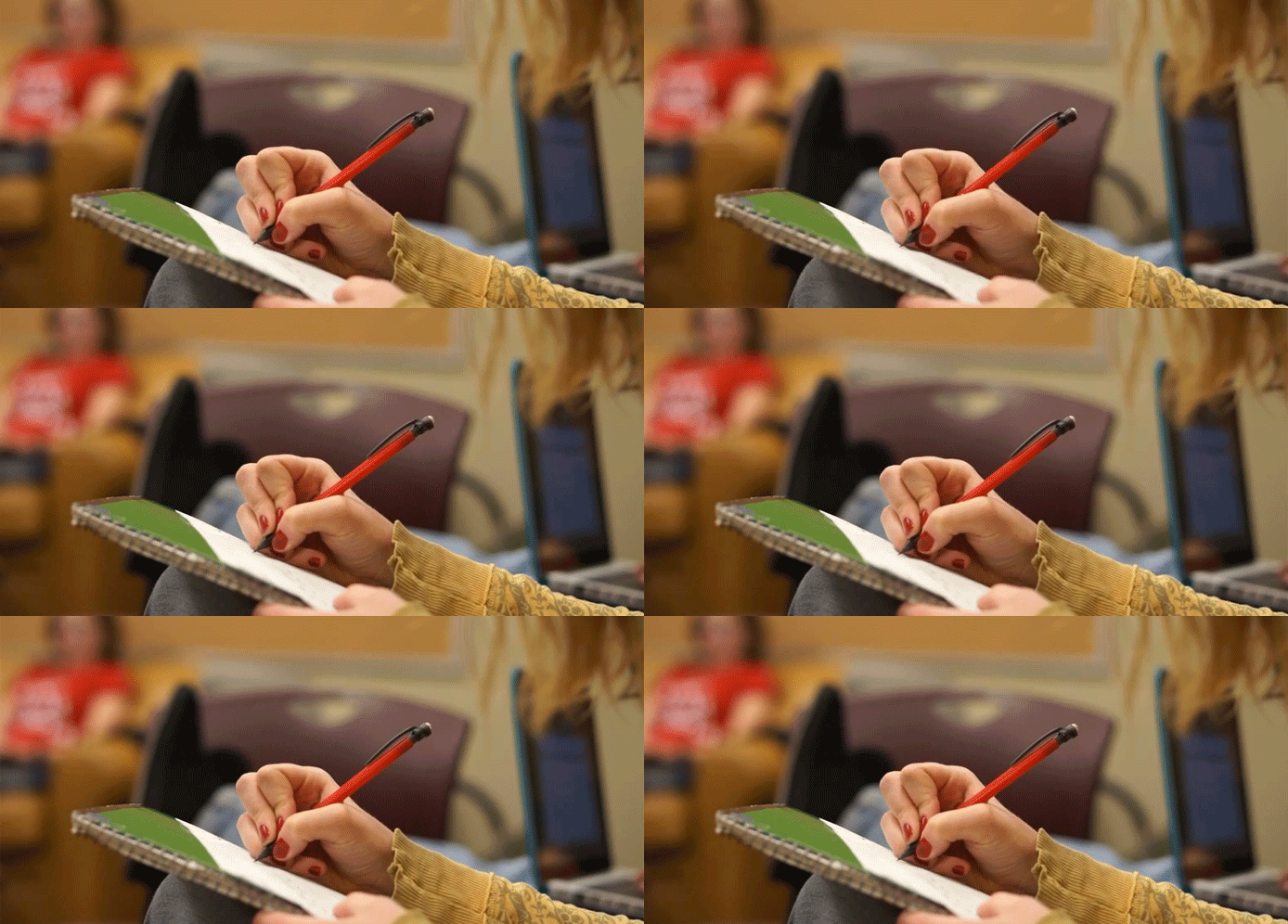
That can definitely apply to me. After I finish a draft, I’ll step away from it for a few weeks, then print it out (double-sided) and have at it with red pen in hand. I go through the whole thing page by page, line by line, marking it up as much as necessary.

Could there be some kind of subconscious connection between holding an honest-to-goodness physical printout in your hands and what it does to your creative process? Beats me, but it seems to really make a difference.

I’m much more likely to spot something that needs to be changed when it’s on a piece of paper rather than on a screen. A line of dialogue that doesn’t work or needs retooling. A scene that doesn’t flow the way I need it to, so I try rearranging it. Or those most common of miscreants – a typo, a misspelled word, or a rogue punctuation mark. It happens.

Sometimes I’ll have a page that’s totally mark-free, or maybe one or two little fixes. Sometimes the page has got more red ink and edit marks than actual text, or my notes and comments occupy a lot of that white space.

All of it – not uncommon.

One interesting side note – many’s the time I’d have to decide about cutting something I was hesitant to cut. I would then figure out what was best for the script and story, and not what I wanted. If cutting this or rearranging that resulted in the scene, and subsequently the script, being better, then so be it. The usual follow-up to that was I’d make the change, then immediately forget about what was cut because the new version was better.

Once all the changes and fixes have been taken care of this draft, I’ll go back to the beginning and start implementing those changes and fixes on the digital copy.

Also not uncommon – trying to read my own handwriting, which can occasionally border on appearing microscopic in size from me trying to cram too many notes on the page. It might take a few passes to read it, but I eventually get there.

Before I know it – voila! A new draft.

Printing out my scripts to do some more work on them in order to make the next draft better is a process that’s served me quite well over the years, and I don’t see any reason to stop doing it.

Let’s start with the basics

I’ve been reading for a contest these past few weeks.

It’s a safe bet to say that a lot of the writers who entered may not be as familiar with how to write a screenplay as one would expect.

This, in turn, inspired some helpful suggestions for any writer to keep in mind:

-SHOW, DON’T TELL. Convey the information in as visual a way as possible.

-GET IN LATE, GET OUT ASAP. Get to the point of your scene as quickly as you can, then move on to the next one. Don’t have the characters chitchatting back and forth for another page.

-GET THINGS MOVING. Get us into the story from the outset. Keep the momentum going.

-EVERY SCENE NEEDS CONFLICT. Two opposing forces; anything from a subtle gesture to an epic battle.

-INVEST IN SCREENWRITING SOFTWARE. It makes a huge difference to write something in Final Draft as opposed to Microsoft Word. This can also help with..

-FORMATTING IS IMPORTANT. If you’re not sure how a script should look on the page, there are tons or resources online with good examples. You can also read some other scripts to get an idea.

-DO YOUR RESEARCH. Fleshing out a story or characters with relevant info adds to the authenticity of the material. Don’t go for the information dump; use what’s important/necessary.

-SPELLCHECK IS NOT YOUR FRIEND. There’s no ‘e’ in ‘lightning’, nor should somebody ‘waist’ an opportunity, just to name two.

-THE THESAURUS IS YOUR FRIEND. Mix it up. There are 142 alternate words for “walk”.

-CHARACTER INTROS. Describe their personality, rather than just their height & appearance – unless either plays a part in the story. Also, their name in ALL CAPS only when they’re first introduced; NOT every single time after that.

-“HOW DO WE KNOW THAT?”. Action lines are for describing what we’re seeing transpire onscreen (i.e. action), not explaining why something’s happening, why somebody’s doing something, or what something really means. Find a way to get that across visually, or through dialogue.

-KEEP IT BRIEF (or WRITE AS IF INK COSTS $1000 AN OUNCE). While a book may allow for lengthy descriptions, a screenplay needs to be tight. Lots of unnecessary text will slow things down, and an important detail might get overlooked if it’s in the middle of a dense paragraph.

-IS THIS IMPORTANT TO THE STORY? While you may consider it vital to meticulously describe the decor of your protagonist’s living room, or every item of clothing they’re wearing, unless that information plays a part in the story, it’s unnecessary clutter.

-IS THIS HOW PEOPLE TALK? Do your characters talk like real people or like they’re in a movie? Helpful tip – read your dialogue out loud to see how it actually sounds.

-ACTIVE, NOT PASSIVE VERBS. “Bob runs” is more effective than “Bob is running.”

-WE SEE/WE HEAR. Personally, not a fan. If you have to use them, do so as sparingly as possible.

-CAMERA DIRECTIONS. Again, not a fan. I find them distracting. You don’t need to remind us we’re “watching” a movie

These, of course, are just the tip of the proverbial iceberg, but still pretty important to keep in mind.

Hope you like receiving what I’m giving

Despite what some may say, it’s actually kind of tough to get a gift for a screenwriter. Straight-up cash – for contests and consultants, of course – is always good, but Murray in the accounting department says Maximum Z’s budget only goes so far, so that’s not an option.

So I figured, how about the next best thing?

You guessed it. Guidance!

So in the spirit of the season, here are some helpful tips that can benefit any screenwriter. One size fits all, the color suits you to a T, and they never fade, run or tear.

WRITE SOMETHING YOU WOULD WANT TO SEE

You like comedies? Write one that could make you laugh out loud. Horror fan? Transfer the scares onto the page. Your taste runs towards small indies? Bet some aspect of your life would be a great foundation for a story like that.

When you go to the movies or sit down to watch something streaming at home, you want your money’s worth. It’s up to the script to deliver on that.

The writer’s love of the material should be evident on the page. The reader/audience will pick up on your enthusiasm for the material, so don’t hold back and have at it. You’re your own target for this, so what would you want to be included in your story?

WRITE AS IF INK COSTS $1000 AN OUNCE

You want the words on the page to really flow, to make the reader keep going and want to turn the page/see what happens next, right? Which do you think will do the job better? Two lines of tight, concise action, or five of excessive prose? I’ve seen both, and prefer the former by a substantial margin.

The subheading for this could be “the more white on the page, the better”. You want to make the absolute most out of that valuable real estate on the page, so why would you want to clutter it up with thick blocks of text? Grab that red pen, put on your editor’s hat, and jump in. Could this dialogue or action be trimmed down from four lines to three? Or two?

The more the writing flows, the faster the read, and the more likely you are to keep your reader’s interest. Try to use as few words as possible; the ones that make the biggest impact.

SHOW, DON’T TELL

You’d think this was a basic one, but I’ve seen a lot of scripts that include what a character is thinking, why they’re doing something, or what something really means.

In other words, “How do we know that?” Film is primarily a visual medium, so if you’re able to present information we can see that’s part of the story, do it!

Here’s an example I like to use:

“INT. KITCHEN – NIGHT

Bob stands at the sink, washing dishes. His mind drifts to when he took Mary Lou to the prom, where she subsequently dumped him and then ran off with a plumber and now lives in Akron with four kids, a cat, and a mortgage.”

What would we see onscreen? A guy washing dishes. That backstory info needs to be presented visually, or as much as can be.

SPELLCHECK IS NOT YOUR FRIEND

True story: I once read a script that included the now-immortal line “She sets a bag of frozen pees on the counter.” I had a lot of trouble focusing on the rest of the script after that. Couldn’t tell you for the life of me now what the story was, but I will remember that line until the very end.

When a writer asks me to look over their script, I’m not just doing story notes. I check punctuation, spelling, grammar, the whole shebang. Having a few goofs is pretty standard; anything more than that and it becomes a problem. Sloppy writing makes it look like the writer isn’t taking this as seriously as they should. Not a great speller, or tend to overdo it with the commas? No problem. I bet there’s a writer within your network who’d be happy to do a polish for you.

DON’T BE BORING

Easier said than done, right? It’s a challenge to make any story interesting enough to hold onto the reader/audience’s attention, but it all starts with what’s on the page. Is the writing flat, or does it really pop? Does the writer have a handful of verbs they use over and over, or have they given their thesaurus a real workout?

Which sounds more visual and intriguing?

He walks into the room.

OR

He struts into the room.

Hint: it’s not the first one. Doesn’t imagining somebody strutting into a room feel stronger, more cinematic, than somebody simply walking in?

The script is your way to paint a picture in our minds using words, and words alone. It’s up to you to do that in as entertaining a way as possible, using the words that pack the most punch.

Does the writing in your script do that?

BE NICE TO PEOPLE/PLAY NICE WITH OTHERS

Another one you’d think would go without saying, but manners do count – especially when it comes to meeting people who could potentially have an impact on you establishing a career.

Which would you rather be – the congenial person who’s interested in what the other person has to say, is open to ideas and suggestions, celebrates somebody else’s accomplishments, and wants to help out, or the bitter, self-important person who constantly whines/complains about how they’re not getting the recognition they deserve, badmouths other writers, won’t change anything in their script because “it’s perfect the way it is”, and just makes it all about them?

This is an extremely tough business to break into, let alone thrive in, so wouldn’t you want as much support as you can get? And every other writer needs as much support as you do, so you should try to help them just as much. Plus, nice people are nicer to be around.

Also important – be honest. Don’t present yourself as something you’re not. If you weren’t telling the truth about one thing, why should anybody believe you about anything else? Sometimes all you have is your reputation, and you don’t want to have it work against you.

Those within the industry would much rather work with somebody who presents themselves as a team player, and not a diva. Cliched as it sounds, you really do only get one chance to make a first impression. Make sure that yours puts you in the best possible light, then you do what you can to keep yourself there.

And that’s it. Hope you get some use out of these, and feel to re-gift as needed.

Wishing you all the best for a happy holiday season that involves a slice of your favorite pie and at least a little bit of writing.

A few takeaways from 40 scripts

Well, that was an experience.

As 2020 wound down, I’d already made the decision to devote 2021 to focus on improving as a writer.

In addition to writing more, that also meant reading scripts more.

I wanted to really work on developing my analytical skills, so on the last day of the year, I put the word out on social media. Want notes on your script? For free? Let me know.

And let me know the screenwriting community did. And then some.

Out of the 75 or so people who responded “Yes, please!”, 40 actually followed through and sent their scripts.

(Apologies to those who missed out. That window is now closed)

It was a fair mix of shorts, pilots, and features.

Since I also wanted to still work on my own material a bit, it all came down to time management. How much time could I dedicate to each script? It worked out to one a day, and about three to four a week.

Granted, these were not the most extensive of notes. Some general observations, questions and comments about the story and the characters, and an insanely large amount of inadvertent proofreading.

I also made sure to preface my notes saying that these were just my thoughts and opinions, so the writer was more then welcome to use or ignore them as they saw fit.

For the most part, the reactions were positive.

“Thank you so much! These are incredibly helpful! This will really help my next draft get to the next level!”

No comments wishing me bodily harm or proclaiming I was an idiot who simply couldn’t grasp their genius, so going with the theory that they approved of what I had to say and just never got around to saying thanks. I’ll ignore this horrific breach of etiquette and still count it as a win.

There was a wide variety of genres and story ideas to be found. Some truly unique and original stuff, as well as more than a few “familiar, but different” approaches to some classic concepts.

What was probably the most surprising result was that the same comments applied to a majority of the scripts, including:

WHAT’S THE STORY?

Since there are no definitive “rules”, I do like to adhere to some strong guidelines regarding structure and plot points.

If I get to around page 25 or 30 and still don’t know what the main story or the protagonist’s goal are supposed to be, there’s a problem.

The writer was too focused on minor issues and details that the main storyline got lost in the shuffle.

SHOW, DON’T TELL, or HOW DO WE KNOW THAT?

A lot of writers would explain what something meant, or what somebody was thinking, or why they were doing it, rather than portraying it visually.

For example, a scene might say something like “Bob stands at the sink, washing dishes. He thinks about the girl he took to the senior prom and how she dumped him to run off with a plumber and now they live in Dayton with four kids and a cranky Pomeranian.”

You know what we’d see on the screen?

Bob washing the dishes.

Or “Jim was lonely.” How would that look?

There was a lot of reminding the writers that film is primarily a visual medium. Describe what we’re seeing and hearing, and let the characters’ actions and words do the heavy lifting.

A subcategory of this is TRUST YOUR READER/AUDIENCE TO FOLLOW ALONG AND FIGURE THINGS OUT

By explaining what we’re seeing or what’s going on, you’re denying the reader/audience the pleasure of figuring things out to help move the story forward.

This might also count as a subcategory, but there were quite a few times a line would say something like “Bob looks to Mary. He apologizes.”, followed by Bob’s dialogue of “I’m sorry.”

I can’t help but think this is because the writer wants to make absolutely sure that you understand what’s happening, so they tell you, and then show you.

Something else a lot of writers fell into the trap of was OVERWRITING (aka BIG BLOCKS OF TEXT)

There would be 4 or 5 lines at a time to describe what was happening in a scene, which for me, really slowed down the read. I want to be zip-zip-zipping along, not taking my foot off the gas to make sure I don’t lose my place.

“The more white space on the page, the better.” Can that paragraph of 4-5 lines be done in 3? 2?

There was also frequent use of “one the best pieces of writing advice I ever got was WRITE AS IF INK COSTS $1000 AN OUNCE” (shoutout to Richard Walter at UCLA) Try to say the most on the page with the least amount of words.

A lot of writers would go into exquisite detail about things not relevant to the plot, such as the decor of an apartment that’s in one scene, or what the extras in the background are wearing, or what happens to a random character in a fight scene. These sorts of things would distract me from following the flow of the primary storyline. I’d read it and wonder “what does this have to do with ____’s story? Would it make a difference if it wasn’t there?”

This one can’t be stressed enough – SPELLCHECK IS NOT YOUR FRIEND!

I get that not everybody has amazing spelling skills, and your eyes might be kind of tired of seeing the same text over and over again. But any writer should really know the difference between ‘your’ and ‘you’re, ‘there’, ‘their’, and “they’re”, and so on.

But when I read that a character “sets down a bag of frozen pees on the kitchen counter”, it makes it kind of tough for me to concentrate on the rest of the story. How can I think about anything else for the next 60-70 pages?

Not sure about spelling or punctuation? A lot of writers make for good proofreaders, so don’t hesitate to ask around for some help.

Friendly reminder – there is no apostrophe in “sees”. It’s “Bob sees Mary,”, not “Bob see’s Mary.” That popped up more than a few times.

Question for anybody who’s ever written a screenplay: do you ever read it out loud? Especially the dialogue. This really helps you get a grasp of how it should sound.

DOES THIS SOUND LIKE SOMETHING SOMEBODY WOULD ACTUALLY SAY?

You don’t want to run the risk of your characters sounding flat or dull, or too “movie-like”, which can include pure exposition (“As you know, I’m the wealthiest man in town who moved here sixteen years ago after striking oil in the Yucca Salt Flats, and now my twin daughters are running against each other for mayor.”) Let your ears be the judge.

Read it out loud. Host a table read (via zoom or eventually in person)

And speaking of dialogue-related items, I try to limit my use of parentheticals as few per script as possible. A lot of the time, they’re either not needed, or can be replaced with an action line (Bob points.) preceding the dialogue (BOB – “Look over there!”).

The context of what the character is saying should convey the appropriate emotion or interpretation. If I had a dollar for every time I saw the use of (sarcastic), I’d have…a lot of dollars.

As has been stated many times on this blog and throughout the screenwriting community, it takes a long time to learn how to write a screenplay, let alone a really good one. I’m not saying I’m an expert, but I believe I have a pretty firm grasp of what it involves, and am glad to have been able to offer my two cents to help other writers improve both their skills and their scripts.

Since this was a pretty significant undertaking, it was also a bit exhausting, so I don’t think I’ll be making the blanket offer again. I’m still open to reading scripts, but am taking a little time off to recuperate and recharge, so drop me a line after 1 April. Schedule permitting, we can work something out.

And a HUGE thanks to everybody who offered to read one of my scripts, which I might take some of you up on as the year progresses.

Okay. Back to work.