Could it get made today?

psycho-house
“Another “boy and his mother” story? Pass.”

Originally, this post was going to be about the multiple changing of protagonists in PSYCHO (which is another great potential future topic), but the more I read about the film and thought about the impact it’s had since being released way back in 1960, it triggered a totally different train of thought.

Every once in a while, when a classic film is brought up in some context or another, the phrase “That could never get made today” will get thrown in. After the recent death of Gene Wilder, his talent was lauded via the mention of several of his most well-known roles. Willy Wonka. The Waco Kid. Victor Frankenstein (“That’s Fronken-steen.”). His performances were vital parts of each film, which no doubt contributed to making them “classics”.

But, as always, it starts with the script. (Incidentally, I don’t think Wilder gets enough credit for co-writing YOUNG FRANKENSTEIN.)

Examining the stories being told, each one has something truly unique about it, and then some. The writer (and subsequently the filmmaker) wasn’t afraid to take a chance and try something completely new and different. Sadly, the studios today aren’t as open to it. Better to play it safe then take too big a chance, which is why we’re seeing so many remakes and re-imaginings. Of course, that doesn’t always work out either (e.g. 2015’s PAN, the recent BEN-HUR remake).

While there are always original and innovative scripts floating around, it’s a lot of time, effort and money to make a film. The only recent original film I can think of is SWISS ARMY MAN, which I admit I haven’t seen yet.

Who hasn’t read a “truly original” script or about one getting a lot of attention, but a lot of the time the writer will go on to work on other projects while the script that started the whole thing gathers dust?

The best exception to this that I know of is Travis Beacham’s spec A KILLING ON CARNIVAL ROW, which drew a lot of heat when it sold in 2005, then continued to garner praise while it languished in development for years before ultimately becoming an upcoming series on Amazon – at last check, anyway.

Budgets are getting higher, and the gap continues to grow between microbudget features and mega-budget tentpoles. It’s getting harder for original material to get noticed, let alone something that screams out “NEW!” It also doesn’t help that the chances decrease if the script isn’t based on pre-existing material. This could be why today you’re more likely to see an original film that’s a low-budget independent, probably written by the filmmaker themselves.

Before that, your best bet of seeing something groundbreaking would have been at the hands of established filmmakers, only because they had that kind of leverage (and the budget) to get their projects made. An unknown writer doesn’t have that kind of luxury. All we can hope for is to connect with somebody who likes the script (and our writing) so much that they’re actually excited to help us take things beyond the “Sure, I’ll read it” stage.

That’s our objective as writers: to write something that’s not only compelling and involving, but so eye-openingly original that the reader is compelled to the point that they need to see this as a movie. Doable, but definitely not easy.

Homework time! Part one – find a script you really consider a game-changer for the same genre as yours and give it a read. Can you identify what made it so unique? What really stands out for you? Plot? Story? Characters? A little of everything? Another option is if that script has been produced, then watch the film and follow along with the script. Are they the same? Totally different? Do you think the changes add or take away from the script?

Part two – without blatantly copying the style of that script, work on applying a similar originality to yours. Did reading that script inspire ways for you to make yours really stand out?

Don’t be afraid to take chances. Strive to offer up something we’ve never seen before. The results might surprise you, too.

-Special offer just for you!
course-discount-maximumz

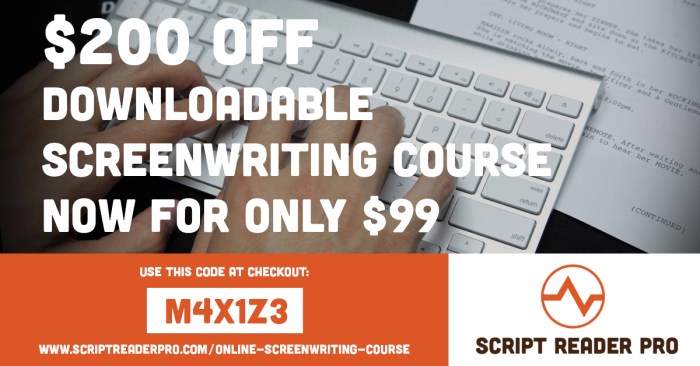
The fine folks at Script Reader Pro are running a discount for Maximum Z readers on their downloadable screenwriting course Script Hackr.

Forget all the confusing and vague “fluff” found in most screenwriting courses, coverage and books. Script Hackr will skyrocket your screenwriting skills by utilizing rarely talked about hacks and hands-on practical exercises to de-mystify theory.

The course retails at $299, but you can get it for just $99 by using the coupon code M4X1Z3 at checkout.

You can check out more details on the course here:

Is the t-shirt THAT important?


oz-bucket
You know that bucket is mentioned a few pages earlier

Writers put onto paper how they visualize the events of the story.

Your get an idea of how you want things to look, maybe even a picture-perfect image, so you put those details onto the page, which is fine.

But sometimes the writer feels the need to include as much detail as they can. “To really paint a picture with words,” they might say. But it’s easy to get carried away. Some writers see this as a golden opportunity to really flex their literary muscles, so they go all out.

A big write-up about the contents of a room. Or identifying specifics about the clothing a character is wearing. That sort of thing.

While that kind of colorful minutiae might work in a novel, many see it as a negative when it comes to screenplays (opinions may vary, but this appears to be the general consensus).

There’s only one reason the writing should be that specific: if the item in question plays a part in the story. Is it vitally important that we notice it? If the answer is “no”, then all it’s doing is taking up valuable real estate on the page.

When the writer makes a point of identifying a particular item, then we should expect it to make a return appearance later on. Set up, pay off, remember?  It’s better to have a reader think “Aha! So that’s what that was for,” rather than “Huh? What was that for?” or “Why was that in there?”

By drawing our attention towards something that is more of an issue for the set designer or wardrobe department, it slows down the story’s momentum and makes for some unsatisfying reading.

Tell us the things we need to know, rather than the things you think would be nice to know.


Quit them or queue them up?

q
As long as we’re emphasizing Qs today…(Yes, it’s a terrible joke. But that’s how we operate around here.)

Today is all about query letters.

I read about other writers who’ve gotten reads, representation, options and even production. There must have been something quite special about those letters (and scripts) to get those machines in motion.

There are also a select number of writers who’ve never had to use a query letter. Bully for them, I say. But I’ve never fallen into that category, so I’m firmly planted in the “those who send” group, which is still fine.

Taking a look at the somewhat limited results of my past efforts and reading about others’ experience makes me wonder in a “big picture” way about the nature and concept of the query letters themselves.

Are they worth the effort?

Naturally, if something happens as a result, of course they are. But even that appears to be a needle-in-a-haystack kind of scenario.

(Incidentally, any tales of query success are more than welcome in the comments section.)

There are so many factors to take into account, including but not limited to:

-who you’re sending to
-what kind of material they want
-they’re intrigued enough to want to read the script
-your script is a good match (or at least close enough) to what they want
-they think your writing’s strong enough
-they think they can make something happen with your script

Several years ago, an agent who’d struck out on their own (along with a sole assistant) told me that their office received approximately 75-100 queries a week. From around the world. Some were good, most were awful. A significant part of each morning was spent sorting through them. As you’d imagine, finding one, possibly two, that clicked seemed to be the norm.

Remember, this was a two-person operation. If they were getting that many, imagine how many the mega-agencies were getting, and still are. Possibly in the thousands.

The chances of success are minuscule, and grow smaller with each progressive step. Those not exactly in the know are more likely to think they’re the exception, but those of us who’ve been down this road before know better.

This isn’t to say that queries never work, but the odds definitely appear to be not in our favor. Luck and timing seem to also play significant parts. Maybe the person you’ve sent to just happens to be looking for a script exactly like yours. I’ve heard it does happen; just not very often.

But the dedicated, persistent and determined among us, including yours truly, will keep at it.

Even though my success rate hasn’t been the best, I’ll continue to do the research, find potential recipients, craft what I believe is a solid query, and send it out.

All that’s left is to wait, hope for the best, and keep busy working on other scripts, each of which will probably also have its own respective query letter get sent out sometime in the near future.

Avoiding the dreaded unfilmable

flagman
Don’t go this way!

I recently had the pleasure of giving notes on a friend’s script. It was an early draft, so it had some of the usual problems that were easily fixable.

But the one thing that really stood out to me was their use of unfilmables.

“Unfilmables?” some might ask. “What are those?”

I’m glad you asked. Here’s an example:

“EXT. PORCH – DAY

Jane sits on the stained deck chair her father bought for her birthday last year.”

If you saw that onscreen, you know what you’d see?

A woman sitting on a chair.

In other words, HOW DO WE KNOW it was a birthday present from her father? We don’t. How can you let us know? Maybe we see the father giving it to her. Or another character asks about it, and she delivers a one-line explanation.

If there’s an important detail to your story, you need to find a way to include it as part of the story, and preferably in the most organic way possible.

What’s on the page is what we see and hear.

Unless there’s a line of dialogue or some kind of action somewhere in there that reveals these kinds of things, the audience has no way of knowing them.

Here’s another:

“INT. KITCHEN – NIGHT

Kevin washes dishes. He thinks about that time he and his high school girlfriend crashed her mom’s car.”

What’s on the screen? A guy washing dishes.

HOW DO WE KNOW that’s what he’s thinking about?

Maybe we see the accident take place. Or hear Kevin talking about it. Maybe the story involves how the accident leads up to him washing dishes.

In my old writing group, one writer was insistent about leaving these sorts of things in. When pressed on why they were so adamant about not being willing to take them out, they’d launch into a long-winded explanation of why it was necessary to include them.

“So if we were watching this, you’d be there explaining things, rather than working them into the story and showing them on the screen?”

I’m not sure if they got the point.

Hopefully you do.

What’s stopping you?

handyman
The ultimate DIY project (film division)

I had the recent pleasure of connecting with a screenwriter who’s working on a feature script, but is also investigating the logistics of developing a short out of it, which includes them having begun connecting with other writers and filmmakers in their area.

I thought that was a great idea, and tossed out the suggestion that maybe they try to make it themselves, as in “just you”. Especially now that most smartphones can double as camera equipment, and film editing software is easily accessible (if not already installed on your computer).

They’d considered this, adding “But I’m just not tech-savvy”.

But you can learn.

If you’re reading this, you’re more than likely interested in screenwriting and/or filmmaking. When you first started out, it’s probably a dead-on certainty that your early works were awful, right?  Looking at some of my first scripts makes me cringe from how bad they are.

But we kept at it, learning and improving along the way. How does your most recent effort compare to that first one? Worlds apart, I’d imagine. You try something, you make mistakes, you learn from those mistakes, and try again.

There’s no reason you couldn’t apply the same logic to making your own short. Sure, there’s a lot more to it than simply pointing your phone and hitting ‘record’, but you gotta start somewhere.

Give it a go and write yourself a short script. Nothing fancy (but do try to make it a good sample of the genre). Anywhere from one to five minutes, spread out over one, possibly two scenes. Two characters, three at best. Try to keep it limited to one location.

Now look at it from the filmmaker’s perspective. Could you feasibly make this yourself? Like how a first draft of a script reads, the end result will not be pretty. At first, you’ll be thrilled at having done it. Then reality sets in and the flaws become that much more obvious.

But you will have done it. A short film, written and produced by YOU.

What you do with it now is up to you. Hopefully, you’ll embrace the learning experience and know what not to do the next time around.

My friend mentioned that once the short got made, which it sounds like they are very intent on making happen one way or another, plans are already being discussed about next steps, which included posting it on YouTube and/or submitting it to some film festivals.

Even though our conversation was solely via email, there was a certain tone to their words that indicated they were quite psyched about jumping into this new venture. I wished them the best of luck and asked to be kept updated as to their progress.

I think they’re off to a pretty good start.