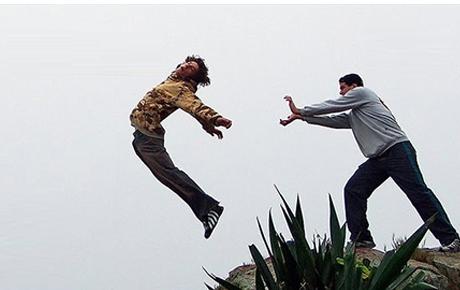
This was originally a clip of “Igor, would you give me a hand with the bags?”, but the greedy jackals at Fox have removed it. This photo proudly takes its place. RIP Mr Wilder
More feedback coming in on the comedy spec, so some tweaking and revamping is underway. Hope to be done with it soon.
In the meantime, I think these previous posts do a more-than-adequate job of summing up what a lot of writers, along with yours truly, probably experience and encounter during this process.
Mine don’t look like theirs yet, but give me time…
Via a writing colleague, I recently found myself in the possession of a pair of scripts written by a pair of pros.
“Open one and read a few words and you’ll be in for the rest of the script,” I was told.
And you know what? They weren’t far off.
I only got a few pages in, but found the writing to be extremely vivid and descriptive. No problem at all in painting those mental pictures with a powerful brush.
My only complaint – all that dazzling wordsmithing got a little too distracting, making it slightly tougher to focus on the story. Nevertheless, I’m looking forward to reading both scripts.
But I totally got my friend’s point: the writing was exceptionally engaging. It really grabbed you and made you want to keep going.
Compared to it, my writing comes across as kind of dry and might even be considered sort of dull and lackluster. Not to totally disparage my own work, but these writers are professionals. I, as it has already been established, am not.
But reading these scripts and others like them are good reminders of what I and every other writer should be trying to do. You don’t want a stick drawing. You want a finely-crafted elaborate work of art.
Speaking from experience, this isn’t easy. It’s almost like learning a new way of writing. It requires a lot of work, nor will it happen overnight.
But don’t despair. The good news is you can start working on these improvements practically immediately.
Take the last scene you wrote. How does it read to you? Does it compel you to want to know what happens next? Feel free to tinker with it until it gets to that point. Then do the same with the scene after it. And the one after that. And so on, and so on.
Think of it this way – you want the reader to “see” the scene in the same way you imagined it. Therefore, your challenge is to write it so the actions, images and dialogue in it come as close as possible to matching your version AND that no other description would do it justice.
Reading these professional scripts was at first intimidating in a “I’ll never be able to write like that!” kind of way. But with a continuous effort and a lot of work, there’s no reason to think I couldn’t come mighty close.
Notes are coming in for the comedy spec, and reactions are pleasantly positive. My always-reliable readers have provided some extremely helpful notes, including an across-the-board opinion about a key plot point.
A lot of what they had to say made some good sense and are really helping solidify the script into something more-than-decent.
While they had nice things to say about the script, each reader threw in an extra little tidbit in the form of comments directed at the script’s writer.
AKA me.
“These two lines of dialogue are an anomaly compared to the rest of it. I know you can do better.”
“Great story, but I’d like to see you dig deeper.”
And these are comments from experienced writers who’ve read some of my other scripts, so they know what I’m capable of. They’re not just saying these things in a casual, generic feedback kind of way, or because they’re trying to be nice. They really mean it, and I take what they say to heart.
I thought the script was okay to begin with, but after getting comments like these, it makes me want to try even harder.
When you’re in the process of putting a script together, you really dedicate yourself to doing a good job, and then try to do better with each subsequent rewrite. It’s how we improve.
But it’s also kind of tough to be able to get yourself past a certain point. You think you’ve done everything you can, but then you get a bit of a supportive nudge and your journey resumes.
It’s quite the confidence booster to know there’s somebody out there rooting for you (especially somebody without a vested interest in you). They want to see you succeed just as much as you do. So you buckle down and throw yourself into making that next draft even better.
End result – you have a stronger script and their belief in you and your abilities is confirmed. Wins all around.
And when the time comes and they ask me for notes on their script, I have a strong suspicion I’ll be able to do the same for them.
Not expecting it to last millions of years, but wouldn’t complain about it either
As an avid fan of summer movies, this year has been one big disappointment after another. Granted, I haven’t seen a few of the latest releases yet (STAR TREK BEYOND, SUICIDE SQUAD), but barely remember anything since CAPTAIN AMERICA: CIVIL WAR, and that came out in early May.
Remember all the hoopla preceding the GHOSTBUSTERS reboot? Kind of died off quickly, didn’t it? We saw it opening weekend, mostly because V wanted to, and it was…okay. I don’t attribute it’s lack of success to angry fans of the original, but because it just wasn’t that great a movie.
Was anything from this summer truly memorable? So far, not really (although I’m still holding out hope for the exquisite-looking KUBO AND THE TWO STRINGS).
It honestly seemed like everything simply wasn’t up to standard. Despite what the various marketing assaults might indicate, the end products felt too slapdash and that too many projects were focused on being ready for the release date rather than making sure the script was rock-solid.
Based on this and almost-daily reports of forthcoming reboots, remakes, and overall more of the same-ness, breaking in as a writer of original material suddenly seems significantly harder. Not only does your script have to really wow ’em, but it better pack a significant wallop on several levels.
A great, new story with phenomenal characters, all told in the most captivating way possible. Simple, no? I realize that a lot of films start with great scripts, but the process that leads up to the film being unleashed on the public can drastically affect it – too many times not for the better.
I’ve always seen my objective as to not only tell you a story that hasn’t been told before (or at least tell an old one in a totally new way), but to tell it in the most entertaining way possible. I want you to not be able to get those images out of your head (in a good way, as opposed to a dear-God-please-make-the-nightmares-stop kind of way).
I’ll be the first to admit that I’d love for one of my scripts to be one of the surprise hits of a summer season, but if recent releases are typical of what kind of material I’m up against, my work is more than cut out for me, if not potentially impossible.
It wouldn’t surprise me if somewhere down the line, my script got turned down because it was deemed “too original”.
After some thorough self-imposed analysis, the revising of the comedy spec is underway. It’s getting easier to spot trouble spots.
There’s one scene in particular that’s giving me some trouble. It’s a pivotal scene involving the main character and offers a revealing glimpse into his backstory. The problem was in figuring out how to best do that.
After much drumming of fingers, rubbing of chin, and a whole lot of attempts, a potential solution may have presented itself. It’s still in the development phase, but for now, quite workable.
One of the first things I learned about screenwriting was what each scene needs to accomplish: advance the plot, the character, and the theme.
Regarding plot, does the scene move things forward? Does it fall neatly into place in terms of how the overall sequence of events plays out? If you took it out, would it totally mess things up?
I’ve read a lot of scripts where something happens and I don’t know why. Maybe it’ll pay off later? Sometimes it does. Other times, well…
Another handy tip when it comes to advancing the plot in a scene: do it quickly. Get to the point of the scene as fast as you can, then get out. Don’t wait around. Just get out now. Too many times I’ve seen a scene drag on much, much longer than it needs to.
Regarding character, does each scene show them changing a little bit more from when they were first introduced? This doesn’t just apply to the main character. Every character needs to grow/develop. Wouldn’t it be kind of boring to read a story where nobody changes?
And tying it into the advancement of plot, every situation the character experiences should help move their own development along.
Which brings us to theme. The message of your story. This can be a little tricky.
Each scene should tie into the theme, or have it on display in some manner. I recently worked with a writer having trouble tying everything together. We discussed the story and the main character’s internal and external goals. What was the message they wanted to convey? Based on those discussions, we were able to come up with a theme that worked for both the story and as it applied to all of the characters.
One of my favorite examples of a theme in use is BACK TO THE FUTURE. Early on, Marty says “History’s going to change.” And boy, does it. We get a ton of set-up in the first act, and then everything does indeed change in the second act as all of those setups are paid off. Amazing.
Take a look at your latest draft. Does each scene advance the topics in question? If not, do you have a way to fix that so it does? The more you get in the habit of doing this, the easier it’ll get and the faster it’ll become second nature to do it all the time.




 Maximum Z