Could it get made today?

psycho-house
“Another “boy and his mother” story? Pass.”

Originally, this post was going to be about the multiple changing of protagonists in PSYCHO (which is another great potential future topic), but the more I read about the film and thought about the impact it’s had since being released way back in 1960, it triggered a totally different train of thought.

Every once in a while, when a classic film is brought up in some context or another, the phrase “That could never get made today” will get thrown in. After the recent death of Gene Wilder, his talent was lauded via the mention of several of his most well-known roles. Willy Wonka. The Waco Kid. Victor Frankenstein (“That’s Fronken-steen.”). His performances were vital parts of each film, which no doubt contributed to making them “classics”.

But, as always, it starts with the script. (Incidentally, I don’t think Wilder gets enough credit for co-writing YOUNG FRANKENSTEIN.)

Examining the stories being told, each one has something truly unique about it, and then some. The writer (and subsequently the filmmaker) wasn’t afraid to take a chance and try something completely new and different. Sadly, the studios today aren’t as open to it. Better to play it safe then take too big a chance, which is why we’re seeing so many remakes and re-imaginings. Of course, that doesn’t always work out either (e.g. 2015’s PAN, the recent BEN-HUR remake).

While there are always original and innovative scripts floating around, it’s a lot of time, effort and money to make a film. The only recent original film I can think of is SWISS ARMY MAN, which I admit I haven’t seen yet.

Who hasn’t read a “truly original” script or about one getting a lot of attention, but a lot of the time the writer will go on to work on other projects while the script that started the whole thing gathers dust?

The best exception to this that I know of is Travis Beacham’s spec A KILLING ON CARNIVAL ROW, which drew a lot of heat when it sold in 2005, then continued to garner praise while it languished in development for years before ultimately becoming an upcoming series on Amazon – at last check, anyway.

Budgets are getting higher, and the gap continues to grow between microbudget features and mega-budget tentpoles. It’s getting harder for original material to get noticed, let alone something that screams out “NEW!” It also doesn’t help that the chances decrease if the script isn’t based on pre-existing material. This could be why today you’re more likely to see an original film that’s a low-budget independent, probably written by the filmmaker themselves.

Before that, your best bet of seeing something groundbreaking would have been at the hands of established filmmakers, only because they had that kind of leverage (and the budget) to get their projects made. An unknown writer doesn’t have that kind of luxury. All we can hope for is to connect with somebody who likes the script (and our writing) so much that they’re actually excited to help us take things beyond the “Sure, I’ll read it” stage.

That’s our objective as writers: to write something that’s not only compelling and involving, but so eye-openingly original that the reader is compelled to the point that they need to see this as a movie. Doable, but definitely not easy.

Homework time! Part one – find a script you really consider a game-changer for the same genre as yours and give it a read. Can you identify what made it so unique? What really stands out for you? Plot? Story? Characters? A little of everything? Another option is if that script has been produced, then watch the film and follow along with the script. Are they the same? Totally different? Do you think the changes add or take away from the script?

Part two – without blatantly copying the style of that script, work on applying a similar originality to yours. Did reading that script inspire ways for you to make yours really stand out?

Don’t be afraid to take chances. Strive to offer up something we’ve never seen before. The results might surprise you, too.

-Special offer just for you!
course-discount-maximumz

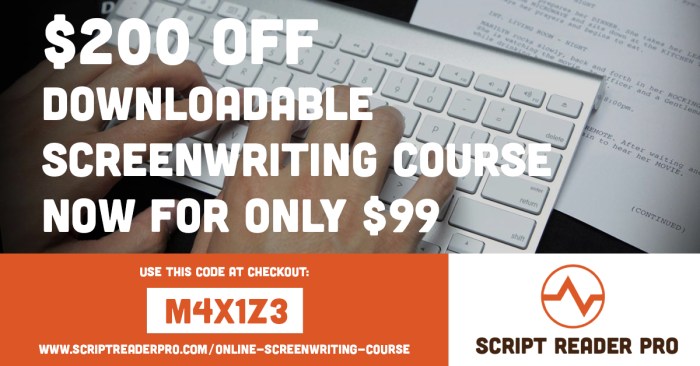
The fine folks at Script Reader Pro are running a discount for Maximum Z readers on their downloadable screenwriting course Script Hackr.

Forget all the confusing and vague “fluff” found in most screenwriting courses, coverage and books. Script Hackr will skyrocket your screenwriting skills by utilizing rarely talked about hacks and hands-on practical exercises to de-mystify theory.

The course retails at $299, but you can get it for just $99 by using the coupon code M4X1Z3 at checkout.

You can check out more details on the course here:
It’s that time again!

New York Author Honored at Cocktail Party
Sparkling wit, bon mots & smart turns of phrase are right at home here

Another three months has passed, making it a more than fitting opportunity to check in with all of you hard-working writers to find out exactly how that writing is going.

That’s right, gang. Put on your public-speaking pants (online edition) and step up to take part in the world-renowned Project Status Update Time!

(insert triumphant fanfare here)

It’s a fairly simple process. In the comments section below, feel free to share with the rest of us what’s new with you and your writing.

Page count. Logline development. Contact with a prodco or rep. Pre-production on a short. Any and all updates are welcome.

As is the tradition, I’ll start things off:

I’ll still give it one more read-through, but I wrapped up the rewrite/polish on the comedy spec. It’s more of a dramedy now, but still quite a charming little story.

I’m also in the process of giving notes on some friends’ scripts, and once all of those are done, it’s onto a pair of new projects. Exciting times, indeed.

How about you?

Just the push I needed

push
What are friends for?

Notes are coming in for the comedy spec, and reactions are pleasantly positive. My always-reliable readers have provided some extremely helpful notes, including an across-the-board opinion about a key plot point.

A lot of what they had to say made some good sense and are really helping solidify the script into something more-than-decent.

While they had nice things to say about the script, each reader threw in an extra little tidbit in the form of comments directed at the script’s writer.

AKA me.

“These two lines of dialogue are an anomaly compared to the rest of it. I know you can do better.”

“Great story, but I’d like to see you dig deeper.”

And these are comments from experienced writers who’ve read some of my other scripts, so they know what I’m capable of. They’re not just saying these things in a casual, generic feedback kind of way, or because they’re trying to be nice. They really mean it, and I take what they say to heart.

I thought the script was okay to begin with, but after getting comments like these, it makes me want to try even harder.

When you’re in the process of putting a script together, you really dedicate yourself to doing a good job, and then try to do better with each subsequent rewrite. It’s how we improve.

But it’s also kind of tough to be able to get yourself past a certain point. You think you’ve done everything you can, but then you get a bit of a supportive nudge and your journey resumes.

It’s quite the confidence booster to know there’s somebody out there rooting for you (especially somebody without a vested interest in you). They want to see you succeed just as much as you do. So you buckle down and throw yourself into making that next draft even better.

End result – you have a stronger script and their belief in you and your abilities is confirmed. Wins all around.

And when the time comes and they ask me for notes on their script, I have a strong suspicion I’ll be able to do the same for them.

No, I’m making all of this up

And here's another reason why you're wrong!
The louder I yell, the more you’ll agree with me

It’s probably safe to assume you’ve found yourself in this situation before:

A colleague asks you to read their material and give your thoughts on it. “Don’t hold back,” they say. “Be as brutal as you need to be. I can take it.”

So you read it, compile your notes (making sure to be critical, but fair and helpful) and send them off. Most of the time this results in one of two ways.

1. “These are great! Thank you so much!”

Or…

2. “What do you mean ____? How could you miss that? Did you even read the script?”

Urgh. I hate, hate, hate when they say that.

Did you want notes or gushing praise? You asked me for the former, but it sounds more like you secretly meant the latter, and now you’re not happy with the results.

If I think your script is good, I’ll say so and tell you why. On the other hand, I also won’t hesitate to point out what I think needs work, or if there’s something I didn’t understand.

There’s no need to remind me how much you’ve slaved over this for months/years, but I’m not going to say it’s good just to make you feel better. You know every single aspect of the story. I don’t, and only comment about what I can (or can’t) see on the page in front of me.

This doesn’t mean I’m a bad reader. Have you considered the remote possibility that your writing just might not be the perfection you think it is? I’ll fetch the smelling salts while that one sinks in.

Believe me, I’m not saying these things to be mean. You asked me for my opinion, and I gave it to you. There are professional analysts and consultants who do the exact same thing, and you’d pay them for it. Not everybody is going to love your script or pick up on every intricate detail you think is painfully obvious to any moron with half a brain.

If you put your script out there for review, you’d better be prepared for the worst. It’s an unfortunate part of how this works.

And one more important piece of advice: getting defensive or arguing with me because I didn’t like your script or “just don’t get it” isn’t going to change my mind, and will definitely make me not want to do this for you again.

Ask an Industry-Powerhouse Script Consultant!

Lee Jessup

The latest in a series of interviews with script readers and consultants who would be worth your while to work with if you want to get your script in shape. Today’s spotlight is on Lee Jessup.

Author of the best-selling book Getting It Write: An Insider’s Guide To A Screenwriting Career, Lee Jessup is a career coach for professional and emerging screenwriters, with an exclusive focus on the screenwriter’s professional development. Her clients include WGA members, Golden Globe and Emmy nominated screenwriters, writers who sold screenplays and pitches to major studios and contest winner. An invited speaker at screenwriting conferences and festivals both in the US and Europe, Lee is a regular contributor to Script Magazine and was the interview subject for a number of film-centric television and web programs. To learn more about Lee and her services, visit www.leejessup.com.

1. What’s the last thing you read/watched that you thought was incredibly well-written?

It’s a cliché, but I always go back to Breaking Bad episodes, which is probably fresh in my mind because I just did that the other night. That’s master craft right there. I’ve been reading a lot of TV scripts lately; one of the best I read recently actually came from a client who wrote a really amazing, intricate pilot with some amazing, innovative character work. Sadly, I’m not allowed to say who. Can’t play favorites!

2. How’d you get your start reading scripts?

I started reading scripts as a kid – my dad was a film producer, and so we always had scripts lying around the house. I thought everyone read scripts and broke them down for fun – it took me a while to get that some people (like my mother) just can’t wrap their brains around reading that format. After all, a script is not fully realized work – it’s a blueprint made to be elevated by imagination.

3. Is recognizing good writing something you think can be taught or learned?

The more you read, the better you learn to recognize quality. When I send my clients to readers, I am always looking for people who are super-seasoned, who’ve read thousands of scripts, because that foundation really informs the reader about what’s out there and  provides a more solid quality barometer. When someone just starts out reading, they can often find promise in the work, whether or not it’s actually there. It’s after you’ve been reading for a while that you begin really evaluating the script for what’s on the page, rather than the potential your imagination allows you to see in it.

4. What are the components of a good script?

For me it all starts with character, so “must-haves” are things like: wound, stakes, clear goal(s), ample conflict. Michael Hauge has a great saying that a strong screenplay rests at the intersection of story and character. That’s a big one for me. Don’t get me wrong – a strong, clear external journey to take us from act 1 to 3 is a must, but if you don’t have that internal journey, that element of taking a protagonist from living in fear to living courageously, you lose me. At the end of the day, I always look to see what the protagonist’s goal was, whether this was achieved or reversed, and if it was done, whether it was done to satisfaction.

5. What are some of the most common mistakes you see?

Page count is the most obvious one. I am sure you’ve heard this before, but I find it to be one that’s very, very hard to recover from because ultimately it’s your first impression. Second is another one of those: not enough white space on the page. The look of the material itself. I recently interviewed Scott Alexander and Larry Karaszewski, and Scott talked about the fact that script pages are meant to be read from top to bottom, not left to right. When I am unable to read from top to bottom, when the script is overly described, then the writer automatically has a serious strike against him. Other things that drive me crazy are scenes that don’t move the plot along, or ones that repeat information we already know without giving us anything new. Hitchcock was famous for saying that in every scene you have to get at least two new bits of plot-relevant information, specifically once you’re out of the first act. That’s a great rule to go by.

6. What story tropes are you just tired of seeing?

I am one of those who believes that anything old can be made new again with a new, different, unexpected take, so in this scenario I am actually open to seeing anything so long as there’s a fresh, interesting voice behind it.

7. What are the 3 most important rules every writer should know?

1. This is a craft; you get better as you go along (which means: write a lot!)

2. Screenwriting is iterative work. No one gets it right on the first draft. This is why you finish a draft, you get notes, you finish another draft, you get another set of notes, etc. It’s all part of the process.

3. While writing great screenplays is critical to screenwriting success, it’s only part of what it will take to build your screenwriting career. Building a screenwriting career takes consistent industry-facing efforts that will help construct and progress your screenwriting career. As a writer, your job is to consistently stoke and manage both the creative fire and your industry-facing, strategic fire.

8. Have you ever read a script that was an absolute, without-a-doubt “recommend”? If so, could you give the logline?

Gonna have to pass on this one if only for client confidentiality…

9. How do you feel about screenwriting contests? Worth it or not?

Winning a big contest is a big deal, which just goes to show that contests are a small-fish/big-pond sort of a game. In order for a win to really work for you, it has to be in one of the biggies, where in truth even high placement goes a long way. For example, every year my clients who place in quarters or semis for the Nicholl Fellowship get multiple read requests from agents, managers and production companies. It’s a way for industry execs to have material vetted for them, and qualified for them to read. In addition, being able to say that you won, were a finalist or a semi-finalist in one of the BIG contests, such as Final Draft’s Big Break or PAGE is generally a door opener. The industry is a bit like the mafia – we need someone to vouch for you. The big contests can certainly help you build that pedigree.

10. How can people get in touch with you to find out more about the services you provide?

Everything anyone ever needs to know about me (and then some!!!) can be found on my website: www.leejessup.com. There’s a full breakdown of how I work, what I do and all the rest of it.

11. Readers of this blog are more than familiar with my love/appreciation of pie. What’s your favorite kind?

Chocolate mousse. Hands down. No question.