It’s probably safe to assume you’ve found yourself in this situation before:
A colleague asks you to read their material and give your thoughts on it. “Don’t hold back,” they say. “Be as brutal as you need to be. I can take it.”
So you read it, compile your notes (making sure to be critical, but fair and helpful) and send them off. Most of the time this results in one of two ways.
1. “These are great! Thank you so much!”
Or…
2. “What do you mean ____? How could you miss that? Did you even read the script?”
Urgh. I hate, hate, hate when they say that.
Did you want notes or gushing praise? You asked me for the former, but it sounds more like you secretly meant the latter, and now you’re not happy with the results.
If I think your script is good, I’ll say so and tell you why. On the other hand, I also won’t hesitate to point out what I think needs work, or if there’s something I didn’t understand.
There’s no need to remind me how much you’ve slaved over this for months/years, but I’m not going to say it’s good just to make you feel better. You know every single aspect of the story. I don’t, and only comment about what I can (or can’t) see on the page in front of me.
This doesn’t mean I’m a bad reader. Have you considered the remote possibility that your writing just might not be the perfection you think it is? I’ll fetch the smelling salts while that one sinks in.
Believe me, I’m not saying these things to be mean. You asked me for my opinion, and I gave it to you. There are professional analysts and consultants who do the exact same thing, and you’d pay them for it. Not everybody is going to love your script or pick up on every intricate detail you think is painfully obvious to any moron with half a brain.
If you put your script out there for review, you’d better be prepared for the worst. It’s an unfortunate part of how this works.
And one more important piece of advice: getting defensive or arguing with me because I didn’t like your script or “just don’t get it” isn’t going to change my mind, and will definitely make me not want to do this for you again.
The latest in a series of interviews with script readers and consultants who would be worth your while to work with if you want to get your script in shape. Today’s spotlight is on Lee Jessup.
Author of the best-selling book Getting It Write: An Insider’s Guide To A Screenwriting Career, Lee Jessup is a career coach for professional and emerging screenwriters, with an exclusive focus on the screenwriter’s professional development. Her clients include WGA members, Golden Globe and Emmy nominated screenwriters, writers who sold screenplays and pitches to major studios and contest winner. An invited speaker at screenwriting conferences and festivals both in the US and Europe, Lee is a regular contributor to Script Magazine and was the interview subject for a number of film-centric television and web programs. To learn more about Lee and her services, visit www.leejessup.com.
1. What’s the last thing you read/watched that you thought was incredibly well-written?
It’s a cliché, but I always go back to Breaking Bad episodes, which is probably fresh in my mind because I just did that the other night. That’s master craft right there. I’ve been reading a lot of TV scripts lately; one of the best I read recently actually came from a client who wrote a really amazing, intricate pilot with some amazing, innovative character work. Sadly, I’m not allowed to say who. Can’t play favorites!
2. How’d you get your start reading scripts?
I started reading scripts as a kid – my dad was a film producer, and so we always had scripts lying around the house. I thought everyone read scripts and broke them down for fun – it took me a while to get that some people (like my mother) just can’t wrap their brains around reading that format. After all, a script is not fully realized work – it’s a blueprint made to be elevated by imagination.
3. Is recognizing good writing something you think can be taught or learned?
The more you read, the better you learn to recognize quality. When I send my clients to readers, I am always looking for people who are super-seasoned, who’ve read thousands of scripts, because that foundation really informs the reader about what’s out there and provides a more solid quality barometer. When someone just starts out reading, they can often find promise in the work, whether or not it’s actually there. It’s after you’ve been reading for a while that you begin really evaluating the script for what’s on the page, rather than the potential your imagination allows you to see in it.
4. What are the components of a good script?
For me it all starts with character, so “must-haves” are things like: wound, stakes, clear goal(s), ample conflict. Michael Hauge has a great saying that a strong screenplay rests at the intersection of story and character. That’s a big one for me. Don’t get me wrong – a strong, clear external journey to take us from act 1 to 3 is a must, but if you don’t have that internal journey, that element of taking a protagonist from living in fear to living courageously, you lose me. At the end of the day, I always look to see what the protagonist’s goal was, whether this was achieved or reversed, and if it was done, whether it was done to satisfaction.
5. What are some of the most common mistakes you see?
Page count is the most obvious one. I am sure you’ve heard this before, but I find it to be one that’s very, very hard to recover from because ultimately it’s your first impression. Second is another one of those: not enough white space on the page. The look of the material itself. I recently interviewed Scott Alexander and Larry Karaszewski, and Scott talked about the fact that script pages are meant to be read from top to bottom, not left to right. When I am unable to read from top to bottom, when the script is overly described, then the writer automatically has a serious strike against him. Other things that drive me crazy are scenes that don’t move the plot along, or ones that repeat information we already know without giving us anything new. Hitchcock was famous for saying that in every scene you have to get at least two new bits of plot-relevant information, specifically once you’re out of the first act. That’s a great rule to go by.
6. What story tropes are you just tired of seeing?
I am one of those who believes that anything old can be made new again with a new, different, unexpected take, so in this scenario I am actually open to seeing anything so long as there’s a fresh, interesting voice behind it.
7. What are the 3 most important rules every writer should know?
1. This is a craft; you get better as you go along (which means: write a lot!)
2. Screenwriting is iterative work. No one gets it right on the first draft. This is why you finish a draft, you get notes, you finish another draft, you get another set of notes, etc. It’s all part of the process.
3. While writing great screenplays is critical to screenwriting success, it’s only part of what it will take to build your screenwriting career. Building a screenwriting career takes consistent industry-facing efforts that will help construct and progress your screenwriting career. As a writer, your job is to consistently stoke and manage both the creative fire and your industry-facing, strategic fire.
8. Have you ever read a script that was an absolute, without-a-doubt “recommend”? If so, could you give the logline?
Gonna have to pass on this one if only for client confidentiality…
9. How do you feel about screenwriting contests? Worth it or not?
Winning a big contest is a big deal, which just goes to show that contests are a small-fish/big-pond sort of a game. In order for a win to really work for you, it has to be in one of the biggies, where in truth even high placement goes a long way. For example, every year my clients who place in quarters or semis for the Nicholl Fellowship get multiple read requests from agents, managers and production companies. It’s a way for industry execs to have material vetted for them, and qualified for them to read. In addition, being able to say that you won, were a finalist or a semi-finalist in one of the BIG contests, such as Final Draft’s Big Break or PAGE is generally a door opener. The industry is a bit like the mafia – we need someone to vouch for you. The big contests can certainly help you build that pedigree.
10. How can people get in touch with you to find out more about the services you provide?
Everything anyone ever needs to know about me (and then some!!!) can be found on my website: www.leejessup.com. There’s a full breakdown of how I work, what I do and all the rest of it.
11. Readers of this blog are more than familiar with my love/appreciation of pie. What’s your favorite kind?
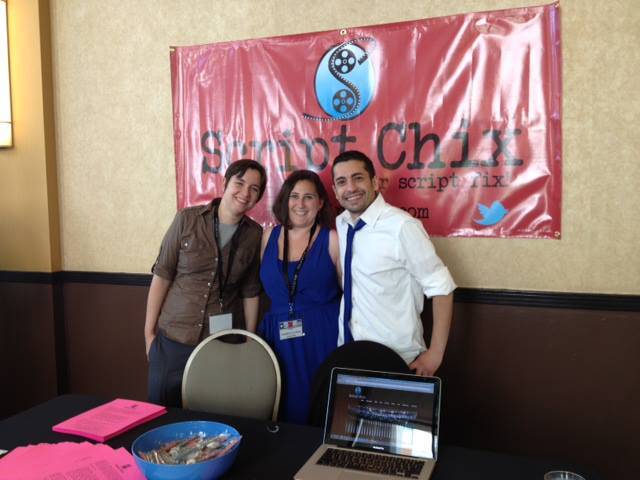
(L-R) Miranda, Sandra & budgeter/scheduler extraordinaire Hosam, who is not part of this interview
*And considering this doesn’t cost you anything to begin with, that’s the best deal you’ll get today.
The latest in a series of interviews with script readers and consultants who would be worth your while to work with if you want to get your script in shape. Today’s spotlight is on Miranda Sajdak and Sandra Leviton of Script Chix.
1. What’s the last thing you read/watched that you thought was incredibly well-written?
WINTER’S BONE
BUTCHER HOLLER by Daniel Shea
2. How’d you get your start reading scripts?
M – Started off as an intern in Hollywood doing the typical script-reading duties. Moved on to being an assistant and continued to do coverage there. Eventually found myself reading for friends and family on the side, and realized (around the same time as Sandra did) that it was a good idea to monetize some of this so as not to just be doing it in my free time. Ended up simultaneously being asked to read for various studios/companies, and turned all that experience around into Script Chix!
S – I believe I read my first script in college, though as a kid, I liked to watch movies and transcribe them. It took hours, but I loved it. The internet wasn’t really a thing yet, so there was no easy access to them. However, professionally, I started reading as an intern doing short coverages for executives during staffing season. My subsequent jobs at an agency and a cable network had me reading all of the time – for potential clients, development, and show staffing. Giving notes to clients, friends, and others who needed feedback was part of my daily life. When I decided to leave my network gig and go out on my own, doing it professionally seemed like a natural transition. As soon as friends at another cable network heard my news, they offered me a spot as one of their book readers. Around the same time, Miranda and I teamed up, and the rest is Script Chix history.
3. Is recognizing good writing something you think can be taught or learned?
M – Somewhat. The biggest thing here is to read as much as possible. We see scripts from writers who clearly don’t read screenplays regularly. The more you read, the more you’re able to recognize. Some of it is likely innate – and it should start early, before you get to Hollywood and decide you want to make movies – but, sure, recognizing what works just comes from reading more.
S – Reading is both objective and subjective. When we give notes, we try to focus on the objective. Even if we personally don’t like a character, a plotline, or concept, we can recognize that it written well, and it’s just not our personal taste. So yes, being able to recognize good writing can be taught; some things are obvious like formatting. However, it takes years of learning and practice to be able to both identify what is good and to be able to separate your own opinions/ taste from it.
4. What are the components of a good script?
S & M – There’s a number of things, but most importantly, a compelling story with multi-dimensional characters. Believable moments that still feel fresh. Strong narrative voice. Imagination and marketability. We would also include formatting in this list. It’s not a sexy component, but it is an important one. The story can be amazing, but if the formatting is off, it’s distracting, and most readers won’t be able to pay attention to greatness of the script.
5. What are some of the most common mistakes you see?
S & M – The biggest one we see, by far, is lack of formatting and proofreading. Bad character introductions. Lazy concept. Writing from experience, but instead of dramatizing the “true story that really happened” to the writer, it’s a regurgitation. Not understanding the difference between edgy and outright offensive or mean. One-dimensional or non-existent women and minorities. Some of these are not necessarily mistakes, but they’re all definitely problems we encounter often.
6. What story tropes are you just tired of seeing?
M – Refrigerator women. Lack of women and minorities. One-dimensional women.
S – Stories about Hollywood, writers, and nights out with the boys. Every writer at some point writes a script about being a struggling writer in Hollywood or their lead male protagonist is a sensitive writer that gets their heart broken. Also behind the scenes of reality TV – this is starting to become a thing. People tend to write what they know and unfortunately, all they know is trying to make it in Hollywood. Unfortunately for them, no executive wants to read this and no audience wants to see it. So if a writer must write this story, do it, get it out of your system, and move on to something more original. Draw from life experience – get out there and enjoy the world, feel heartbreak, and get into trouble (but not too much). The “night out/ retail job with the boys picking up women” is also the most common one we see in fledgling comedy writers. It’s another case of writing what you know. These stories don’t work because they are usually re-tellings of actual experiences that are not particularly dramatic or funny to anyone outside of the people who experienced it. Additionally, the humor only comes from insulting women. Just because making fun of a woman was hysterical to you and your boys in the moment doesn’t make it funny or appealing to anyone else.
7. What are the 3 most important rules every writer should know?
M – Write. Read. Revise.
S – Persistence, practice, and patience.
8. Have you ever read a script that was an absolute, without-a-doubt “recommend”? If so, could you give the logline?
M – Yes! And it just finished shooting! “A teenage con artist tricks a desperate mother into hiring her as a live-in companion for her autistic daughter.”
S – I agree with M. That script is amazing. Honestly, it’s tough to give a blanket “recommend” because each company and client we work with has their own specific mandates of what they are looking for, so it needs to be tailored to their needs. A script that I loved recently, like goosebump-inducing loved is “With the help of a crotchety old neighbor and his garden, a young woman’s world comes alive.” It sounds a bit generic, but it was beautifully written and full of magic with a hint of surrealism.
9. How do you feel about screenwriting contests? Worth it or not?
S & M – Absolutely worth it, but not all of them. Do your research. See which contests have a track record of success for the writers who’ve won. Look at what the prizes are. If the only prize is that you won the contest, it’s probably not that worthwhile (unless it’s a big name like Nicholl or Page). And look at things like fellowships, as well. If they want you to pay but aren’t giving you anything WORTHWHILE in return, it’s not worth it.
That said… if you’re starting out and still sending out queries and you haven’t won anything or been published or produced – enter contests. Get some prestige next to your name, even if it is just “winner of miscellaneous contest.” It helps in general, but it mostly helps if the contest is considered reputable.
10. How can people can get in touch with you to find out more about the services you provide?


 Maximum Z