Opinions may vary

Wanted to try something a little different today.

While there are standards for formatting in scripts, there are a few topics that seem to cause more debate than expected.

Such as:

-sluglines. Bold or not?

-Spaces after a period. One or two?

EDIT: -Since this initially posted, a few writers chimed in with using FADE IN and FADE OUT. I might have used FADE IN when I first started, but soon stopped. As for FADE OUT, I favor FADE TO BLACK or maybe SMASH BLACK. Something to put that note of finality on it.

I’m sure there are others, but these two came immediately to mind.

For the record, I think bold sluglines look better on the page, and have always preferred one space after a period (although somebody in a recent conversation said “it has to be two”).

I thought about “two brads or three?”, but don’t think that’s much of an issue anymore. Can’t even remember the last time I read a printed script that wasn’t mine.

I’m sure more experienced writers – especially those who’ve been produced – will say none of it matters. Probably, but I think it’s still an interesting discussion.

What’s your position on these topics, and are there others that seem to have two distinct schools of thought?
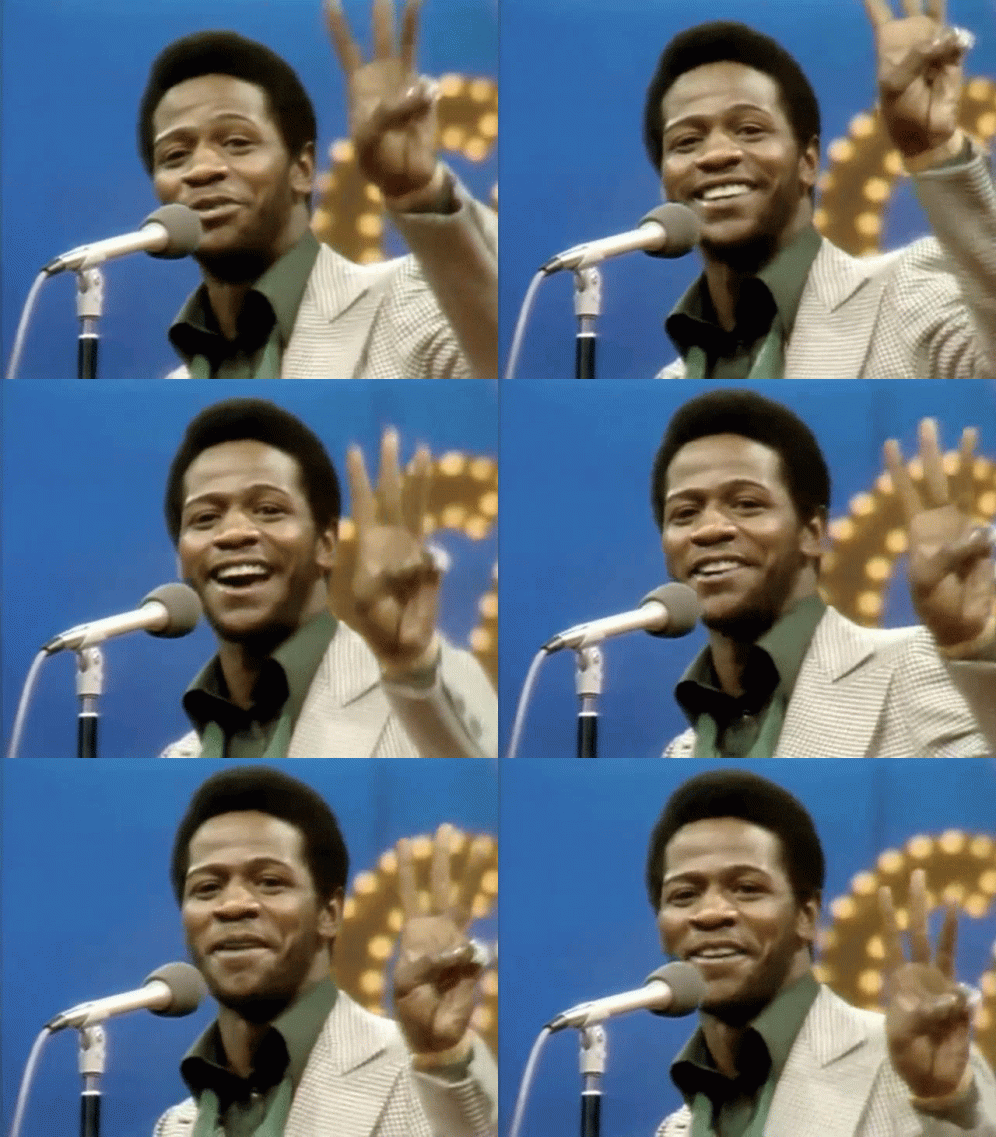
The other three little words

My, what a rough week this was.

PAGE semifinalists and Nicholl quarterfinalists were announced. My script was not on either list.

Disappointing, especially since I think it’s a pretty solid script.

At least that’s what my readers say.

But like you always hear: it’s all subjective.

Your first thought when you get that notification that includes “Unfortunately,…” is probably “I must be a really shitty writer”.

Not so. I’ve read a lot of scripts of exceptional quality that also didn’t advance, including one by a previous Nicholl top 10 finalist.

There is absolutely no way to tell how a script is going to do in a contest. You send it, hope for the best, then move on to whatever the next thing is.

After I’d posted about not advancing, more than a few writers responded in kind.

“Me too.”

“Another swing and a miss.”

“Whoo! My eighth consecutive year of not advancing.”

It’s taken me a lot of time to accept that while it’s great to see your script do well in a contest, when it doesn’t do well is no absolute reflection on you as a writer.

Again: it’s all subjective.

One writer I know was frustrated after years and years of their script never doing well in a contest. That script then went on to place in the top 50 for the Nicholl.

This isn’t to say that your script couldn’t do with a little more work. That’s really up to you.

If you’re among the horde of writers whose contest journey has come to an end, give yourself a minute to vent and air those grievances, then decide what you’re going to do about it.

Is your script as solid as it can be, or would it be worth your while to give it another read to see if anything could use some tweaking?

Something to also keep in mind: winning a contest can be a stepping stone to a career as a writer, but it’s not the only way. A script can not do well in a contest but still attract the attention of somebody interested in making it.

As another writer put it: “I’d rather write a script that would be a good movie, than one that wins contests.”

At this point I don’t know what my plan is for next year’s contests. I’m too busy working on scripts to worry about it.

Which reminds me of another three important little words:

Don’t. Stop. Trying.

Create your own doorway

Had a great Zoom chat the other day with a newer writer. They’d found me on social media and liked what I’ve had to say about screenwriting and working on establishing a career at it. Would I be open to imparting some of what I’ve learned and any other advice I might have that could potentially help point them in the right direction?

Even though I admitted to still being one of those trying to “break in”, so my two cents of guidance was probably worth about that much anyway, how could I say no?

We talked about wide variety of topics, mostly involving screenwriting, including our respective backgrounds, experience, short- and long-term goals. They also asked for potential suggestions as to how they could go about achieving those goals.

I told them what I’ve said to many writers before, and it still rings true.

Everybody’s path to success (however you gauge it) is going to be unique to them and them alone. What works for me will probably be totally different than what works for you. If you know what your goals are, then it’s up to you to figure out what it will take for you to get there.

You need to create your own doorway, because nobody’s going to do it for you.

Use everything at your disposal. You might think you don’t have anything to work with at first, but you’d be surprised how effective even the littlest thing can be. It’s all about perspective and determination.

For example, the writer had worked on some short films in various capacities. They could use those to showcase their skills, as well as adding the other filmmakers and crew into their network. You never know who knows of another gig or has heard of a project that needs someone who can do the things you do.

If that’s what it takes for you to find that way in, that’s what you do.

The writer said nobody had put it that way before, which really helped them as they start to figure out their approach and possible strategies. They appreciated the advice, and the honesty.

This sort of stuff might seem pretty basic to those of us who’ve been at it for a long time (such as yours truly), but there will always be those just starting to dip their toes into these turbulent waters. I didn’t really have anybody like that when I was starting out, so why not offer up a helping hand in some capacity?

Now if you’ll excuse me, I’ve got a doorway to finish creating, followed by kicking it wide open.

Knowing your nails and how to use them

Savvy and experienced consumer of literature I’m sure you are, no doubt you’re more than somewhat familiar with the classic piece For Want Of A Nail:

For want of a nail the shoe was lost.
For want of a shoe the horse was lost.
For want of a horse the rider was lost.
For want of a rider the message was lost.
For want of a message the battle was lost.
For want of a battle the kingdom was lost.
And all for the want of a horseshoe nail.

Sometimes we don’t realize how important something is that at first glance might seem completely insignificant.

The same concept could apply to screenwriting and the details of your story. A reader could see something and wonder “I don’t get it. Why is this in here?”

If you do the work and plan accordingly, the answer/reason will soon be obvious. That little detail is there for a reason, probably an important one, and without it, the rest of the story won’t work.

This is important on several levels.

It shows you put a lot of thought into putting the story together.

It shows you understand the concept of effective setups and payoffs.

It shows you respect the intelligence of your reader/audience and don’t feel the need to deliberately draw our attention to this sort of thing.

It always bothers me when a story sets something up and doesn’t pay it off, or has something later on in the story that comes out of nowhere.

Some writers go into it with a solid idea of how everything is set up and know how it’s going to play out, some come up with the bare bones of a foundation and fill in the blanks, and there are even those who sit down with a blank page, start writing, and see how it goes.

I tend to waver between the first two.

Sometimes you might even go back over what you’ve already written and discover an opportune moment to put in a small detail that can further enhance something later on in the story. It’s as if your subconscious was working in conjunction with your creativity and giving you an unexpected helping hand.

Are parts of your story set up that they start with a “nail” and escalate from there? Or does something happen later that could use a stronger setup?

You’d be surprised at seeing the ripple effect one little change can have on the rest of your script. Hopefully for the better.