Every one a delight in itself, and none of the calories
In a recent Twitter exchange, the person with whom I was conversing mentioned, “You’ve covered a lot of ground with your blog.”
I never really thought of it that way. I just try to write about stuff I consider both appealing and applicable for writers. Sounds like others might share the same opinions, which is always nice to hear.
Since I’ve been doing this for a good number of years, the catalog of posts goes back quite a ways, covering a wide spectrum of topics. Despite their age and the occasional outdated writing update, the intended content of many of them remains relevant.
With that being said, here are a few posts from the past couple of years I think still make for informative and entertaining reads.
Here it is the last day of June, signifying the halfway point of 2017, which means it’s time once again for that most lauded of blogpost topics:
The Project Status Update!
This is your opportunity to give as much or little info as you desire regarding what you’re currently working on, finished so far this year, or plan to jump into in the coming months.
Mine’s pretty simple and straightforward.
-Currently revising two scripts – a comedy and the pulp sci-fi spec. Already have a spec rewrite project lined up for when both of those are done – target start date is end of the summer.
-On the non-writing front, I’m signed up to do 4 half-marathons between now and the end of the year. A slight chance that number might potentially increase by one or two, but it remains tentative. As long as I can keep my time under the 2-hour mark, I’m good.
So how’s 2017 been for you, writing-wise?
A few items from the bulletin board:
-Filmmaker Steve Davis has launched a crowdfunding campaign for his World War 2-era short No Glory on Indiegogo. Looks pretty cool. Donate if you can!
-Even though the focus around here is mostly on screenwriting, a lot of writers are also interested in writing for television. The National Hispanic Media Coalition TV Writers Program is accepting applications from Latino writers between now and August 7. If you qualify, give it a look-see!
-If you’re a screenwriter in the San Francisco Bay Area (or the general northern California area, or just happen to be in town that weekend), the NorCal Screenwriters Networking Shindig will be taking place from 2-4pm on Sunday, July 30th, at Kawika’s Ocean Beach Deli at 734 La Playa (between Balboa & Cabrillo, just a block from the Pacific). Let me know if you’re interested in attending. Hope you can make it!
Bit of a shorty today as I’m steamrolling my way through several projects at the moment. This includes revising two of my own scripts.
As part of the effort to make the next drafts of both that much better, I’m trying to take the time to read scripts in the genres of both. Why not glean what I can from prime examples?
The learning truly never stops.
Added bonus – a lot of these are just fun to read.
This is one of those basic pieces of advice that every screenwriter, no matter their experience level, needs to heed on a regular basis:
Read scripts.
Study them. Use them for the learning tools they are and wring every last bit of help out of them that you can.
Everything really is right there in front of you. 90-110 pages of primo learning material. Pages and pages of “See what they did there?” Take notes. See what’s there and NOT there.
Take it a step further and read a script of a film while watching that film. How do they compare? Lots of similarities? Lots of differences? Do the actions onscreen do justice to the words on the page?
Apply what you learn to your own script. It might help more than you realize.
Side note – DO NOT copy that writer’s style. You’re working on establishing your own voice. No good can come from trying to sound like somebody else.
A just-starting-out writer had contacted me, asking if I could take a look at their spec.
I did. It wasn’t easy, but I did.
The script had a lot of the usual problems. On-the-nose dialogue. One-dimensional characters. A story that was more a jumbled collection of random events rather than a cohesive series of scenes and sequences.
But even with all of that, what really stood out was the excessive overwriting when it came to setting up a scene, with excessive being a major understatement. The writer seemed to feel the need to provide an extraordinary amount of details – for just about everything.
Just to name a few:
-What kind of furniture is in every single house or apartment
-What kind of food is on the table during a dinner scene
-Why a character, who’s only in one scene, is wearing a particular item of clothing, along with what it looks like
-A detailed list of all the items of clothing a character removes when getting undressed
-The direction a character is driving, along with street names
Did any of these have anything to do with the story?
All together now – of course not.
Then why is it in there?
I posed this question to the writer as part of my notes. They haven’t responded yet, but it’ll be interesting to see what they say about it.
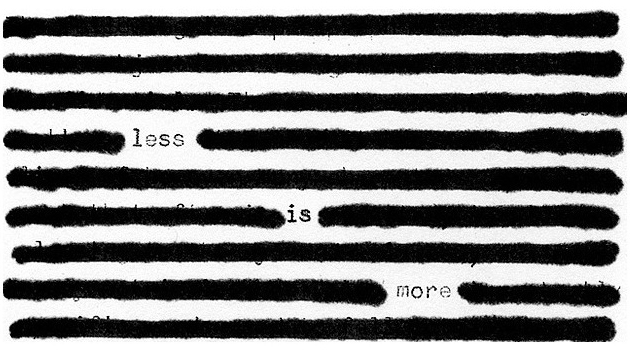
I can’t remember the specific joke/comment about sculpting, but it’s something along the lines of “Start with a block of marble, and then chip away everything that doesn’t look like a (whatever you’re sculpting).”
Screenwriting’s very similar. While it’s true you should describe what we’re seeing, there’s no need to drastically overdo it. Some writers don’t know the difference between “painting a picture with words” and “overwhelming us with information”. Or worse, think they’re more or less the same thing.
They are most definitely not.
Everything on the page should have a reason for being there. If it doesn’t, take it out. Trust me, it will not be missed. If you argue that it should stay, you better have a mighty good reason why. Helpful tip – saying “Because I want it to” or “Because I like it” will totally invalidate your argument.
When the writing goes into Overly Descriptive Mode, it simply slams the brakes on the momentum of the story; things really do come to a screeching halt. Wouldn’t you rather the reader stayed interested in what’s going on, and not think “Hold on a second. Why is this here? Is it relevant?”
For a lot of writers starting out, they think they need to cover all the bases and include as much info and detail as possible. Only through constant self-educating will they eventually learn what they should and shouldn’t be doing.
I sincerely hope this writer takes my notes to heart and is able to figure out how to transition from the latter to the former.
The man responsible for tales of time travel, alien invasions, and assorted mad scientists, just to name a few…
After a gap of several years, I recently had the opportunity to reconnect in person with a respected colleague who has had more than their fair share of experience dealing with writers of all shapes, sizes, and levels of talent.
This person used to deal a lot with screenwriters, but now deals primarily with writers of manuscripts. Over the course of our conversation, I was asked about my scripts and my writing (What do I like to write? What genres are the scripts I have now? What kind of stories am I working on?)
As has been documented here before, my genre of choice is definitely adventure, along with hyphens connecting them to other genres (i.e. western-adventure, pulp sci-fi adventure, etc).
I gave a quick thumbnail sketch/five-second elevator pitch for the two completed and the one currently in revision mode.
You’d be harder pressed to find a stronger advocate for using your already-existing material as a springboard to jump into other mediums – primarily books and/or graphic novels.
It was their opinion that all three sounded like very original and fun ideas, which would make each a prime candidate for attracting attention. And this person has also been following the blog for quite a while, so their opinion is also that my writing is pretty solid. They cited examples of writers they knew who’d foregone the traditional route of trying to get in with one of the high-profile publishing houses and done it all themselves, each achieving respectable levels of success. Nothing to break the bank, but still some impressive numbers.
“A script is more or less an outline for a novel. And even though you’re not limited by page numbers, it still takes talent to create a novel,” I was told. “Your stories are original and unique, which makes them prime candidates for this. At least think about it.”
Believe me, I am.
My success in trying to get these scripts through to reps and production companies has been practically non-existent at best, yet I persist. I’m sure I’ll continue along that avenue, but this new alternative is definitely food for thought.
I’ve been told by more than a few people that my writing is very visual (which you would think would make it ideal for film), and that it really moves. In the past, I’ve entertained and even at times partially investigated the notion of applying my scripts to a graphic novel format (a great match), but am also not averse to trying my hand at converting it to pure prose.
I’ve no intention of stopping writing scripts. I like it too much. But I also like the pure act of writing by itself, so for the time being, all this talk about working in other formats is nothing more than speculation and conjecture.


 Maximum Z