Trying to unlock a key moment

skeleton-keys
One of these HAS to be it

I was hoping to wrap up the polish/revision of the comedy spec this week. Everything was going quite smoothly until I hit a bit of snag when I got to the end of Act 2 – only one of the most important parts of the story. Where things are definitely at the lowest point possible for our hero.

The general consensus of my readers was that the hero was too passive, and therefore needed to be much more active and stand his ground, yet still end up failing. Some suggestions were made, and I’ve been working on making it stronger and more effective.

Which brings us back to right now. As it reads, it’s just not working.

And that’s kind of frustrating.

I know there’s a solution to this, and my creativeness has been working constantly to come up with one that not only works with the context of the story, but seems plausible and believable.

As I said to one of my readers, I tend to overthink this kind of thing. To which they responded with “Remember, this is a story that’s supposed to entertain.”

And that’s pretty important, too.

Hopefully when all is said and done, it’ll do all of it.

-I ran the Giant Race half-marathon on Sunday. Got a small rock in my shoe around mile 7 or 8, but opted to keep going rather than sacrifice the time to remove it. The rock eventually was a non-issue and I managed to just beat my ongoing goal of 1:55 by one whole second – 1:54:59.
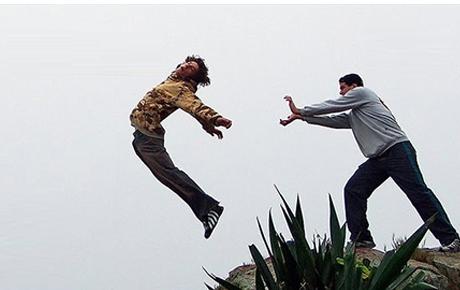
Just the push I needed

push
What are friends for?

Notes are coming in for the comedy spec, and reactions are pleasantly positive. My always-reliable readers have provided some extremely helpful notes, including an across-the-board opinion about a key plot point.

A lot of what they had to say made some good sense and are really helping solidify the script into something more-than-decent.

While they had nice things to say about the script, each reader threw in an extra little tidbit in the form of comments directed at the script’s writer.

AKA me.

“These two lines of dialogue are an anomaly compared to the rest of it. I know you can do better.”

“Great story, but I’d like to see you dig deeper.”

And these are comments from experienced writers who’ve read some of my other scripts, so they know what I’m capable of. They’re not just saying these things in a casual, generic feedback kind of way, or because they’re trying to be nice. They really mean it, and I take what they say to heart.

I thought the script was okay to begin with, but after getting comments like these, it makes me want to try even harder.

When you’re in the process of putting a script together, you really dedicate yourself to doing a good job, and then try to do better with each subsequent rewrite. It’s how we improve.

But it’s also kind of tough to be able to get yourself past a certain point. You think you’ve done everything you can, but then you get a bit of a supportive nudge and your journey resumes.

It’s quite the confidence booster to know there’s somebody out there rooting for you (especially somebody without a vested interest in you). They want to see you succeed just as much as you do. So you buckle down and throw yourself into making that next draft even better.

End result – you have a stronger script and their belief in you and your abilities is confirmed. Wins all around.

And when the time comes and they ask me for notes on their script, I have a strong suspicion I’ll be able to do the same for them.

Time for the editor to take over

editor
Where’s the ‘delete’ key on this thing?

The latest undertaking: the edit/rewrite of the low-budget comedy spec is underway.

Even while I was writing it, I knew there were changes that needed to be made. So now it’s time to dive in and make those changes, which tends to be equally as thrilling as the actual writing process. For me, anyway.

This is the part where I force myself to let those changes be made, even for the parts I absolutely love. There will most likely be more than one instance of “Why did I think this was a good idea?” Then I change it.

It happens with every draft of every script. You have to be able to be your own harshest critic. Every decision stems from “How can this be better?”

Sometimes it comes easy, and sometimes it doesn’t. It takes a while to get the hang of it.

“But why not just do it while you’re writing that initial draft?” some may ask. Because you don’t always hit the bullseye on your first attempt. You need a couple of practice tries. Many’s the time I’d suddenly stumble into a solution that proved to be significantly better than the original.

Don’t hold back. Don’t be afraid to make those changes. As I’ve discovered many times in the past, once something is changed, it is very soon forgotten. So much to the point that you’ll barely remember the previous incarnation.

When this whole process is done, at least for this round, I believe the end result will be a better script. I’m fairly confident this won’t take too long, and think writer-me will be quite content with the decisions made and steps taken by editor-me.

And then the whole thing will repeat itself again.

*Side note – blogger-me is proud to announce that the number of visitors to the blog has surpassed the 20-thousand mark. Not too shabby, especially considering the first few years were me and about six other people.

Thanks for reading, everybody!

A little post-comp analysis

scientists
Studying the script data at Maximum Z Labs

The results are in for my standing in two highly-ranked screenwriting contests, and at best could probably be considered partially encouraging.

As mentioned previously in this space, my western did not advance to the quarterfinals of the PAGE International competition. That was somewhat disappointing.

Earlier this week, I’d been informed that it made the top 15 percent for the Nicholl, and was also not advancing to the quarterfinals. This ranking ties a previous personal best. Not bad, but again, slightly disappointing.

As it would probably be for most, my initial reaction to both of these announcements, especially the former, was “Well, I’m just a shitty writer, aren’t I?”

Apparently, not necessarily.

After I’d announced my contest results, I heard from a lot of fellow writers, including comments about the quality (or lack thereof) of the scripts that advance, the quality (or lack thereof) of the readers, but the most-repeated one was:

“It’s all subjective.”

Very true. We produce what we believe to be the absolute best script we can, and either someone’s going to like it, or they’re not. And there’s nothing we can do about it.

If you were also among those of us whose scripts didn’t advance, take heart. It ain’t the end of the world (although it may feel that way). Use this as a learning experience and work on improving your script so it’s ready for next year. Get notes on it. Rewrite. Polish. Whatever you think is necessary.

It’s also important to keep in mind that these contests are not the be-all and end-all. Winning them or placing high doesn’t guarantee a career. Sure, a handful of past finalists are working writers or consultants, but they appear to be the exceptions.

Just to put things in perspective, a friend of mine was a recent Nicholl finalist and says it had zero impact on their career, and still struggle to get their material read.

In all honesty, the sheen of contests is starting to wear a bit thin for me. I’ll probably still enter the western again next year, along with two other scripts I’m hoping to complete, but I’d rather focus on getting my material sold or produced, or at least using my scripts as strong calling cards and writing samples to get assignment work. I’m not picky. Whatever it takes.

There are a lot of ways to break in and become a working writer. Contests are one, but definitely not the only one.


A workload on steroids

Man drowning in stacks of paperwork
All I need to do is cut out the non-essentials. Who needs food, sleep or oxygen anyway?

I’m in the home stretch for the November writing project. I got into Act 3 over the weekend, and think there about 10-12 pages left before I can call it a day. No reason I can’t wrap things up in the next couple of days. Estimated final page count should be somewhere in the mid-90s, so pretty much where I was hoping it would be.

My original intent was to put that on the back burner once it was done and shift my focus to another script, but something else has developed that definitely requires my attention: other people’s work.

Over the past couple of months, I’ve been very fortunate to have gotten some fantastic feedback from friends and trusted colleagues. Now it’s my turn to return the favor.

Actually, make that favors. Plural.

Every time I’ve asked someone if they’d be willing to read and give me notes, I always offer to do the same for them. And several have taken me up on the offer.

Which is totally fine. I just didn’t expect all of them to happen within such a short timeframe.  But it’s cool. Just requires a little planning.

Some script-related items, two scripts requiring special attention (with a bit of a time limitation), and at least 4-5 others getting straight-up notes. Yeah, that’s a lot, but I’d feel pretty shitty if I didn’t reciprocate the kindness all of these folks extended to me.

While I’d love to keep the 2-pages-a-day momentum going clear through to the end of December and have at least part of a draft of another script, taking care of these is now top priority.

It may take me a little longer than I expect, but I always strive to honor my commitments. I said I’d do something for you, and by gosh, I’ll do it.

It’s the least I can do.