Gosh, what a full plate!

primanti bros
It’ll take time, but feeling confident I’ll accomplish that which I set out to do. (In the meantime, anybody up for Primanti Brothers? (Pittsburgh shout-out!))

My projects over the next couple of months are shaping up nicely.

-Finish overhauling the outline for the comedy spec and convert it into pages

-Some more fine-tuning on the pulp sci-fi (courtesy of a steady influx of good notes)

-Maybe one more pass on the western. Yeah, I know. But I recently got some keen insight on a few parts which could do with a little improvement.

The potential is still strong for all three, both in terms of contests and queries.

I have to say that this time around, my analytical and editing/proofreading abilities feel a bit stronger. Not that they’re the pinnacle of perfection, but at least slightly more developed than, say, a few years ago. That’s a definite plus. Nor would I hesitate to take full advantage of the sage advice of my squadron of savvy readers.

I feel a bit more prepared now, as well as a little more confident about ending up with a triad of really solid scripts.

That’s the hope, anyway.

Another part of my enthusiasm comes from seeing the results of some of the major screenwriting contests, some of which I entered and didn’t fare as well as I’d hoped. I’ll work on these scripts, send ’em out and hope for the best.

On a brief side note, I recently read the comment on an online forum – “Waiting for notes. What should I do to occupy my time?”

I suggested “Start working on your next project.” It’s what I would do. Can’t think of a better way to get your mind off a finished script than starting a new one or digging into the archives and touching up an older one. Gets the creativeness pumped up and really does help pass the time.

Anything that lets you flex your writing muscles while adding to your arsenal of material can only be seen as a good thing.
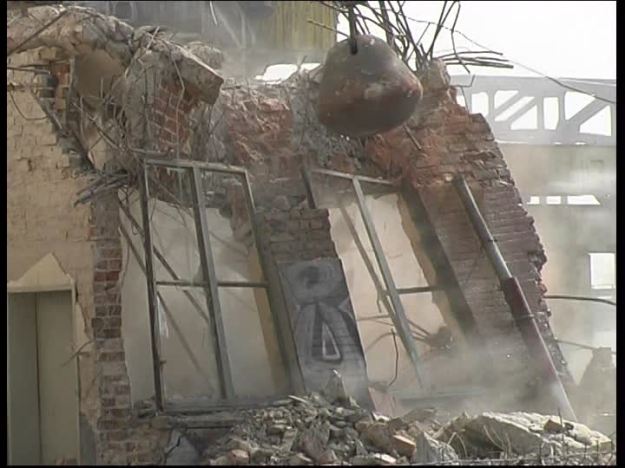
Out with the old…

wrecking ball
Just clearing away some stuff I don’t need anymore…
Seeing as how I’ve designated this latest go-round with the comedy spec as an “overhaul”, it’s only fitting that that’s what actually happens.

I’d decided I was absolutely not going to use the previous draft as reference material. This approach was going to be more than just the slapping on a new coat of paint and rearranging the furniture.

Granted, there were some select parts that survived the trip from the previous draft to the new one, but only because they’re vital components of the story, which makes them still relevant. Everything else, however, would be fresh and new.

And as you’d expect, that’s been slightly tougher. Tough, but not impossible.

Developing changes in a rewrite can really test one’s mettle and determination. Sometimes I’ll feel stuck and think “How’d I do it before?”, but then I fight the temptation to dig up the previous outline, reminding myself I’m in overhaul mode. Looking at the previous draft would counteract what I’m working towards now – to try something new.

There’s always a different path to where you’re trying to go.

I suppose part of it is the occasional lazy writer approach of considering what’s come before as “good enough” and not really changing it that much, but if it were “good enough” to begin with, I wouldn’t be working so hard on changing it this time, right?

Some days I’ll produce a wonderfully long sequence in no time flat, while some will yield a meager handful of bullet points of important moments that need to happen within the context of that scene or sequence, and took a dreadfully slow hour just to come up with.

Despite all of this, the results so far have proven encouraging, with work about to begin on a totally-from-scratch sequence. Forward progress is slow, but steady – as it should be.

I suspect the end result will be significantly and pleasingly different from its previous incarnation. And I wouldn’t have it any other way.

-two new items posted to the Maximum Z Bulletin Board!

-Screenwriter Kay Tuxford, director Prathana Mohan, and producer Edward Timpe have launched the crowdfunding project for The MisEducation of Bindu, a new and original take on the typical high school film. The script was a Nicholl semifinalist, so you know it must be some high-quality stuff. Donate if you can!

-Starting today and running until September 30th, screenwriter Max Adams is offering up a limited time half-off special on script consultations. Go to the contact link on the website to email her for details.

Drastic, possibly foolhardy, but definitely beneficial

Window Cleaner
Sometimes extreme measures must be taken, no matter how challenging

Work on the outline of the comedy spec continues – with a most interesting development.

But first, a little backstory…

When I first approached this rewrite, I knew it needed a lot of work. A LOT. So I decided not to call it a rewrite, because it was much more than that.

“Overhaul” seemed perfectly appropriate. So that’s what I was calling it.

Problem was, that even with some quality notes, I wasn’t sure how to go about it. When I take on a rewrite, I’ll usually refer to the previous outline and see what I can do to change things around.

But that wasn’t working this time. Quite the opposite, actually. I was feeling stuck, making zero progress, which in turn was making me feel annoyed and frustrated. I was more and more in desperate need of some kind of solution.

I had a solid concept, but it was the execution that was giving me trouble. I knew where I wanted to go, but was having trouble getting there.

When I provide notes on a script, if I read something that feels flat or unoriginal, I’ll suggest “Try a totally different approach that gets us to the same point. Do a 180, or make a hard left – anything to really shake it up!”

It’s worked for other writers, so why not apply that sage wisdom to myself?

So I did.

It’s a lot easier to suggest “Wipe the slate clean and start over!” than it is to do the wiping and starting over.

But so far it appears to be just the solution I was seeking.

Although somewhat intimidating at first, the blank page soon became filled with new ideas and variations on old ones. Certain details remain the same, plus a few odds and ends, but for the most part, it’s become a much different journey to the original destination.

It was also surprising how easily the new material popped up. By not keeping myself chained to the previous draft, I was allowing myself the freedom to just try new stuff.

There’s still a lot of work to do, but it’s a most satisfying start.

A subject worth discussing

soapbox
Listen up, and listen good

Stepping onto my proverbial soapbox to utter a few thoughts on something that needs to be said.

If you’re part of an online forum, and you post your material in that forum seeking feedback from other members, you will get all kinds of responses. Some will be positive, and some will be negative – maybe to point of being outright condescending.

How do you respond to the positive ones?

“Thanks. I appreciate it.” Maybe elaborate a little, or a follow-up question or two. Possibly even ask to communicate with the person in private.

The negative and/or condescending ones?

“Thanks.”

That’s it. No matter how much you feel the urge to respond with a stinging retort written in ALL CAPS and a lot of exclamation points, just don’t. You asked for comments and you got ’em.

A thick skin is a necessity in this business. Arguing or getting angry because you don’t like what somebody said won’t help you or your writing, and it makes you look petty and unprofessional.

Now let’s address the other side.

Somebody asks you for notes, and based on the quality of the material, you do the best you can, trying to be as helpful as possible. Be honest with your suggestions of what needs to be fixed.

Does it have potential? Mention that. Are there problems? Identify them and how they could be fixed.

If the writing reflects an amateur, or a poorly constructed idea, point out how and why in a constructive manner. There’s no need to be insulting or talk down to them. Chances are they’re still learning, so they don’t know as much as you do.

They may not like what you have to say, maybe even going so far as to insult you and your experience, or deride your comments. But that’s on them. You’ve done your part.

So let’s review.

You want help? Take what you get, even if you don’t like it. After your temper cools down, take a serious look at what was said. There may be something in there worth using.

Somebody asks you for help? Be professional and as helpful as you can. Don’t hold their lack of experience against them.

No matter whether you’re giving or receiving, be patient, tolerant, and open-minded.

Keep that in mind, okay?

Thanks. The soapbox is now available.

That’s not the question you should be asking

classroom
Class, who can tell me what “familiar, but different” means?

I see variations on this question a lot throughout many online forums:

What kind of script should I write?

Seriously?

And I say that in the least condescendingly way possible.

It amazes me that somebody who wants to write a script has to ask what they should write. Shouldn’t you already know? Isn’t that why you’re doing this in the first place?

Then again, I’ve always been a writer, so it was never a question of “What do I write?”, but more of “Which one do I write now?” and “How do I write this so it’s good?”

But back to the topic at hand…

My immediate response to the question in question is “Write something you would want to see.” But that’s my approach. Others may take a different stance.

One caveat – make sure whatever you write is as original a story as you can come up with that contains original characters and situations. Do whatever you can to make it your own. Readers will instantly recognize if you’ve “borrowed” something.

I recently read a script that was a blatant rip-off of a well-known franchise. Did the writer know this when they wrote it? I don’t know, but the actual concept behind their story seemed unique unto itself, with lots of possibilities, so it was actually kind of surprising and disappointing to see them follow that well-trod path instead of seeking out something new.

Something else to keep in mind – using well-known characters not created by you is a very, very bad idea. A writer friend has a connection at Marvel Studios who handles the non-stop influx of unsolicited spec scripts. No doubt your Spidey spec is brilliant, but you’re seriously fooling yourself and wasting your time.

Wouldn’t you rather your script be known for offering up something new and unique?

A lot of newer writers see what’s hot at the box office and think “I can crank out something like that in no time!” Also a waste of time. Trends come and go very quickly. What’s hot today could be ice-cold tomorrow. And you probably think you’re the only one to come up with some variation on that current big idea.

You’re not. It’s even money deals involving clones of that idea will be announced in the near future, all while you’re still churning out pages.

DON’T CHASE TRENDS. You’ll never catch up.

A writer I’ve exchanged notes with concluded our most recent email conversation with “Also wanted to pick your brain. I want to write a script about ____ . It’s an idea I’ve had for several years, but I don’t know if anyone would want to see it.”

Their concept seemed good with lots of potential, but also sounds very similar to a recent series on Netflix, which I thought increased the chances of inevitable comparisons between the two. But if it’s a story that’s been percolating for that long and they feel really passionate about it, then by all means, have at it.

As a spec writer, you have the freedom to write whatever you want. I suspect a lot of us are inspired by the films we grew up watching up to the ones we enjoy now.  Start there and see where it takes you.

Strive for originality, chums.