My Austin experience

The 30th Austin Film Festival is in the books, and I had the pleasure of attending for the first time. There was also the bonus of my script being a Second Rounder. Twice. More on that in a minute.

Before I went, a friend who’d been there several times offered up some very sage advice:

“Don’t go expecting it to be a career-launcher. While that might be a remote possibility, go with the intent of meeting people, maybe learning a few things about the craft, and most importantly – to have a good time.”

I took all of those to heart, and it most definitely paid off.

For me the absolute best part was getting to meet an extraordinary amount of people I’d only known through social media; a lot of writers I’ve interacted with for years. It was fabulous to be able to talk with them face-to-face. Whether it was over coffee or drinks, a meal or just waiting in line for one of the many panels, just being able to chat (or shout, depending on the location) with each other was extremely pleasant.

Like a lot of writers, I can be quiet at first before I feel comfortable enough to open up and be more social. In the days leading up to the festival, I was terrified it would be another one of those “Everybody’s talking to somebody while I’m just sitting/standing here by myself”-type of situations.

And I hate those.

More than a few people told me it’s very easy to start a conversation in Austin. You see somebody wearing a badge and just start talking. I figured I’d give it a try.

The easiest place to do this was in line, of which there are MANY. A bit awkward at first, but this ended up happening a lot. One of my favorite parts was asking somebody about their script or scripts, which were listed on their badge if it had placed. I love seeing and hearing a writer talk about their work – you really can see their excitement about it on display. I even got a few “I’d love to read that” in response to them hearing about mine – always nice.

Another great thing was the wide variety of panels being offered. I think this will be the last time I’ll feel the need to go to any of the “how to break in”-type panels. While the information was good, none of it was anything I hadn’t already heard many times before. I didn’t mind attending them, but next time I’ll be able to focus more on the ones that feel a little more tailored to my kind of writing (e.g. Deconstructing the Action Movie, Tentpole Storytelling, etc.).

With my script being a Second Rounder, I had the opportunity to attend some roundtable panels, which involved industry pros chatting with some of us at a table for about 12-15 minutes, then moving on to another table. The ones I got to hear ranged from TV writers to a screenwriter who’s had several films produced over the past few years.

Regarding my earlier comment about my script being a Second Rounder twice. I’d entered the animated fantasy-comedy before the early bird deadline, but then did a few rewrites on it and thought it was a lot better, so I rolled the dice and entered it again before the final deadline. I felt it was worth paying another entry fee. I was thrilled when I got the phone call saying the script was a Second Rounder, but then remembered I’d entered it twice. Was this for the first or second entry? The first, I was told. This gave me hope that the second entry might have a shot at making the semifinals. A few weeks later, another phone call came in to congratulate me for my script being a Second Rounder. Not what I was hoping for, but still really nice to hear. It was the first time a script of mine ever made Second Round, so to also be attending the Festival for the first time was a double-win.

One of the things that wasn’t as great a match for me was the late night activities. Much as I wanted to take part, a combination of decades of my body being used to getting up in the middle of the night for work and non-stop activity from dawn to dusk resulted in me being totally spent at the end of the day. Hitting a party or visiting a bar at 11pm or midnight might work for some, but not this guy

I could talk about other peripheral things like where to stay, good places to eat & drink, and that sort of thing, but that’s more of an individual choice. Part of the fun was the exploring of the downtown Austin area. Although I will add that dinner at Gus’ World Famous Fried Chicken was phenomenal.

If you’re a screenwriter who hasn’t had the chance to attend the Austin Film Festival, it’s something I highly recommend. It’s truly an experience you won’t forget and hopefully be one you’ll be eager to repeat. I don’t plan on doing any contests for 2024, so I’ll probably skip going to Austin next year; more likely ’25 or ’26. Or as one of my friends put it: “You should come back when they’re talking about the movie that you wrote.”

I like that option the most. Working on it.

**One more thing: I tested positive for Covid upon my return home. Another first-time experience, and another reason this trip will be truly memorable. This has also happened for several other friends, so if you haven’t tested yet, DO SO IMMEDIATELY and take the appropriate action.
Behold the tactile experience

A few weeks ago, I printed a copy of the animated fantasy-comedy, and then posted on social media about holding the actual document in my hands and the sensations that resulted from doing that.

(Quick note – said sensations were of a very positive nature. There’s definitely something to be said about holding a physical manifestation of all the time and effort you put into this draft. It’s exhilarating. Uplifting, even. A true sense of accomplishment. And then eagerly accepting the next step of figuring out what’s wrong with it and how to fix it/make it better.)

The post yielded quite a wide spectrum of responses. From “Totally agree. It’s fantastic!” to “I can’t imagine NOT printing it” to “You still print out scripts?”

As I matter of fact, I do. I find it to be incredibly helpful when it comes to editing, proofreading, and overall polishing.

As more than a few people put it, “Printing out a script is a necessary part of my process. I can see things on a page I’m holding that I might not see on a screen.”

That can definitely apply to me. After I finish a draft, I’ll step away from it for a few weeks, then print it out (double-sided) and have at it with red pen in hand. I go through the whole thing page by page, line by line, marking it up as much as necessary.

Could there be some kind of subconscious connection between holding an honest-to-goodness physical printout in your hands and what it does to your creative process? Beats me, but it seems to really make a difference.

I’m much more likely to spot something that needs to be changed when it’s on a piece of paper rather than on a screen. A line of dialogue that doesn’t work or needs retooling. A scene that doesn’t flow the way I need it to, so I try rearranging it. Or those most common of miscreants – a typo, a misspelled word, or a rogue punctuation mark. It happens.

Sometimes I’ll have a page that’s totally mark-free, or maybe one or two little fixes. Sometimes the page has got more red ink and edit marks than actual text, or my notes and comments occupy a lot of that white space.

All of it – not uncommon.

One interesting side note – many’s the time I’d have to decide about cutting something I was hesitant to cut. I would then figure out what was best for the script and story, and not what I wanted. If cutting this or rearranging that resulted in the scene, and subsequently the script, being better, then so be it. The usual follow-up to that was I’d make the change, then immediately forget about what was cut because the new version was better.

Once all the changes and fixes have been taken care of this draft, I’ll go back to the beginning and start implementing those changes and fixes on the digital copy.

Also not uncommon – trying to read my own handwriting, which can occasionally border on appearing microscopic in size from me trying to cram too many notes on the page. It might take a few passes to read it, but I eventually get there.

Before I know it – voila! A new draft.

Printing out my scripts to do some more work on them in order to make the next draft better is a process that’s served me quite well over the years, and I don’t see any reason to stop doing it.

At least buy me a drink first

Pop quiz!

You’ve got a script you’re quite excited about. You’ve slaved away on it and now can’t wait to show it off to the rest of the world.

But you want to make sure it’s as good as it can be, and that means getting feedback.

Who do you ask?

Is it:

A – a professional script consultant

B – somebody in your network of writers

C – a total stranger you just met. Like, minutes ago

And the answer is…?

Okay. Pencils down.

It would be nice to think that common sense, logic, and professionalism would influence your answer.

A and B are both correct.

Unfortunately, there are some who think it’s C, and are very adamant about that decision.

I was recently on the receiving end of such a scenario. A writer had asked to connect on a social media platform, I accepted, and within a matter of minutes received links to a trailer and pitch deck for their script.

I responded with a blunt “thanks”, to which they said they were looking for help to improve the script.

I said I’d try to think of some suggestions for consultants and services they could check out.

They were hoping I’d do it, to which I responded “I charge for notes too”.

They took that as “I accept your offer, and will now work with you!” and sent an NDA for me to sign.

I’m sure you can guess what my reaction to that was.

I tried to end it by saying that starting a connection with “Thanks! Read my stuff! Help me!” was not the way to go. Shockingly, they failed to get the point and kept going.

There were a few other issues that came up, so let’s just say the rest of our exchange proceeded to go downhill like an out-of-control bobsled on fire.

FOR CRYIN’ OUT LOUD – DON’T DO THIS!!

I get it. The enthusiasm. The heightened adrenaline. The hope/daydream that anybody who reads your script will immediately proclaim it “best ever!”

What a lot of writers, both new and those still learning, fail to comprehend is that part of being successful at screenwriting is establishing and maintaining professional relationships. You can’t just jump right in with a total stranger and say “You don’t know me, but I want you to help me”.

Would you want to be on the receiving end of that? Of course not. So why do some writers feel it’s a savvy move? If anything, you’re sabotaging yourself before you even get started.

It’s essential to take the time to build your personal network, and one of the key phrases here is “take the time”. Nothing happens in the blink of an eye. It requires patience, tact, and civility.

Putting in the time and effort to be a good screenwriter isn’t only about the writing. Knowing how to play well with others is just as important.

Be nice to people. Treat them how you’d want to be treated. Help them out if/when you can.

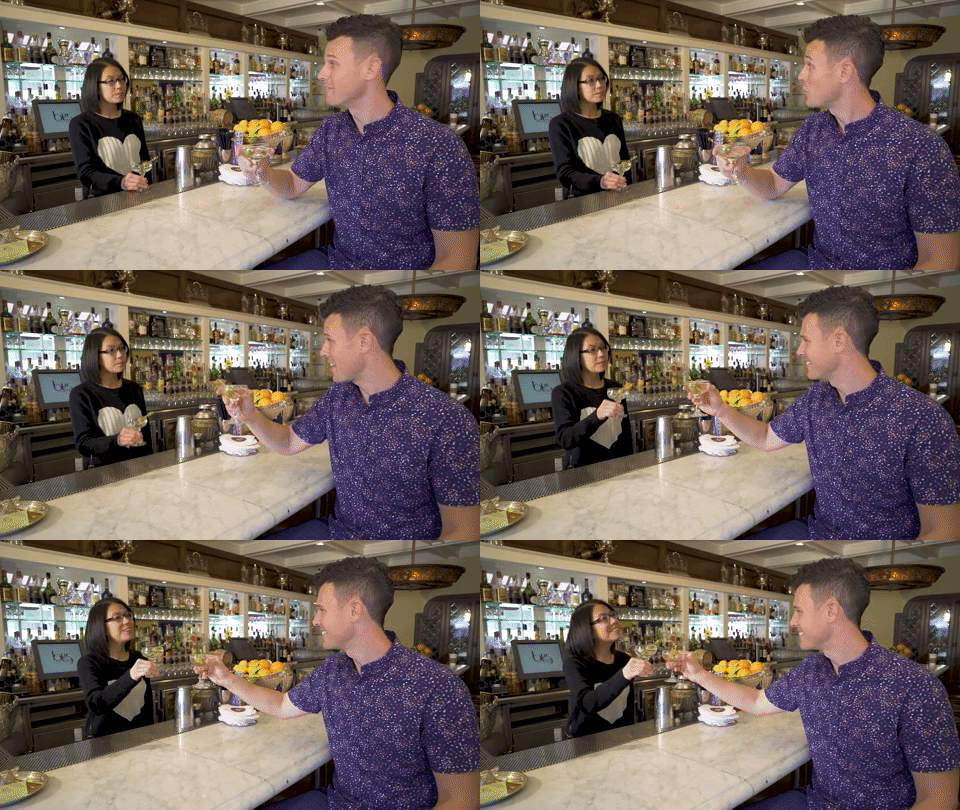
Then you meet for drinks.

That’s how you do it.

Which one are you?

I’ve been very fortunate over the past few years to have connected with writers from literally all over the world. Strong professional relationships have been established and maintained (when possible). Because of these strong bonds, it’s not uncommon for me to receive an email from somebody in a far-off location with a question, a request, or seeking a recommendation.

And more than a few times I’ve been the one sending an email of that nature.

Each of these relationships took time to develop. Nothing was instantaneous. Most likely it was the result of somebody responding to something one of us said on social media. Even if I don’t know the person, I’ll treat them with courtesy, respect, and the occasional self-deprecating joke.

Wouldn’t trade any of these connections for anything. Maintaining contact with other writers is good on several levels. It makes me feel like part of the community. It’s great to talk shop about our respective projects or our experiences. Doing all of this reminds me that there are LOTS of other people out there going through the same sorts of things.

Then there are those who feel the need to showcase their “expertise” by throwing shade on my question or comment.

“Well, that’s stupid”

“And you think this is a good idea because…?”

“I hate to tell you this, but that won’t work”

And the always-classic “Don’t take this the wrong way, but…”

The only reason I’d give a second thought to this kind of reaction is if it were from somebody with whom I’ve established that professional relationship. They’d also say it in a more constructive manner with the intent to help, rather than denigrate.

Admittedly, there will always be somebody I don’t know or haven’t interacted with, but am connected with in some capacity. For the sake of this argument, that’s pretty much the equivalent of talking with a stranger. If you see the need to go negative under the guise of “telling it like it is”, why should I even pay attention to you? These sorts of reactions tend to guide me to the “Disconnect” or “Unfollow” button and give it a hearty click without a moment’s hesitation.

I’m always open to connecting and interacting with other writers, but respect is a two-way street. I’ll treat you the way I’d want to be treated, and hope you feel the same.

If not, well, it was nice knowing you and good luck with all your future endeavors.

Moral of the story: Be supportive, encouraging, and sympathetic when possible. Repeat.

Still a thing?

That little paper box full of extra cards is tucked away somewhere

A few weeks ago, I had the pleasure of being interviewed on the Telling The Show podcast to talk about networking as it relates to screenwriters.

Over the course of the discussion came this question: in pre-COVID times, it wasn’t uncommon for a writer to have a business card. Does a writer still need one?

I thought it was a great question, and had to really think about it.

My initial thought is probably not, especially due to how most networking is now done online, and most writers have their phone with them, so contact – or at least reaching out – can be practically instantaneous.

What good is having a card to hand out when you’re practically isolated and there’s nobody around to hand it to? These days you’re more likely to connect with somebody via a social media platform, so you’ll probably do everything via email and/or texting in order to set up meeting one-on-one.

A lot of writers now have a strong online presence – websites, blogs, an account on Youtube, Twitter, Instagram, etc., so it’s significantly easier to get in touch with somebody to strike up a conversation, or at least establish a professional relationship.

Keeping that in mind, in-person interaction is slowly coming back, so if we get to the point where you show up at a venue where you don’t know anybody, and then have some nice conversations with people, would you want to have a card to hand out, or be comfortable asking for their email address?

There are exceptions, of course. A majority of writers tend to be on the introverted side, so dealing with a real live person can be somewhat intimidating. This makes online networking easier for some people. Somebody quiet and shy in person might be more involved or outgoing on a Zoom call or on Twitter.

Just as an example, I recently tweeted a compliment to the hosts of another screenwriting podcast regarding the interview they did with a high-profile manager (I also included the manager in the tweet). Both hosts and the manager liked it, and another writer friend of mine added in his two cents, leading to a brief discussion among all of them.

I didn’t do it because I was trying to suck up to the hosts or hope the manager would offer to read something; it was because I liked what I’d heard, and wanted to let them know that. Would I have achieved the same results if this had been done in person? I’m going to go with “slightly maybe, but probably not to the same extent”.

Online interaction is one of the things I encourage for writers seeking to expand their network. Nobody’s going to get to know you if you hang back and stay quiet. Become involved. Join conversations. Just make sure to be polite, civil and respectful.

There are forums and group chats to take part in, as well as lots of screenwriting groups on Facebook. I find the smaller ones to be better because the members tend to be more experienced, more mature, and of a more rational temperament.

Networking and interacting has really changed, especially over the past few years. But one thing remains the same: online or in person, business card or no, be the kind of person you’d want to know.