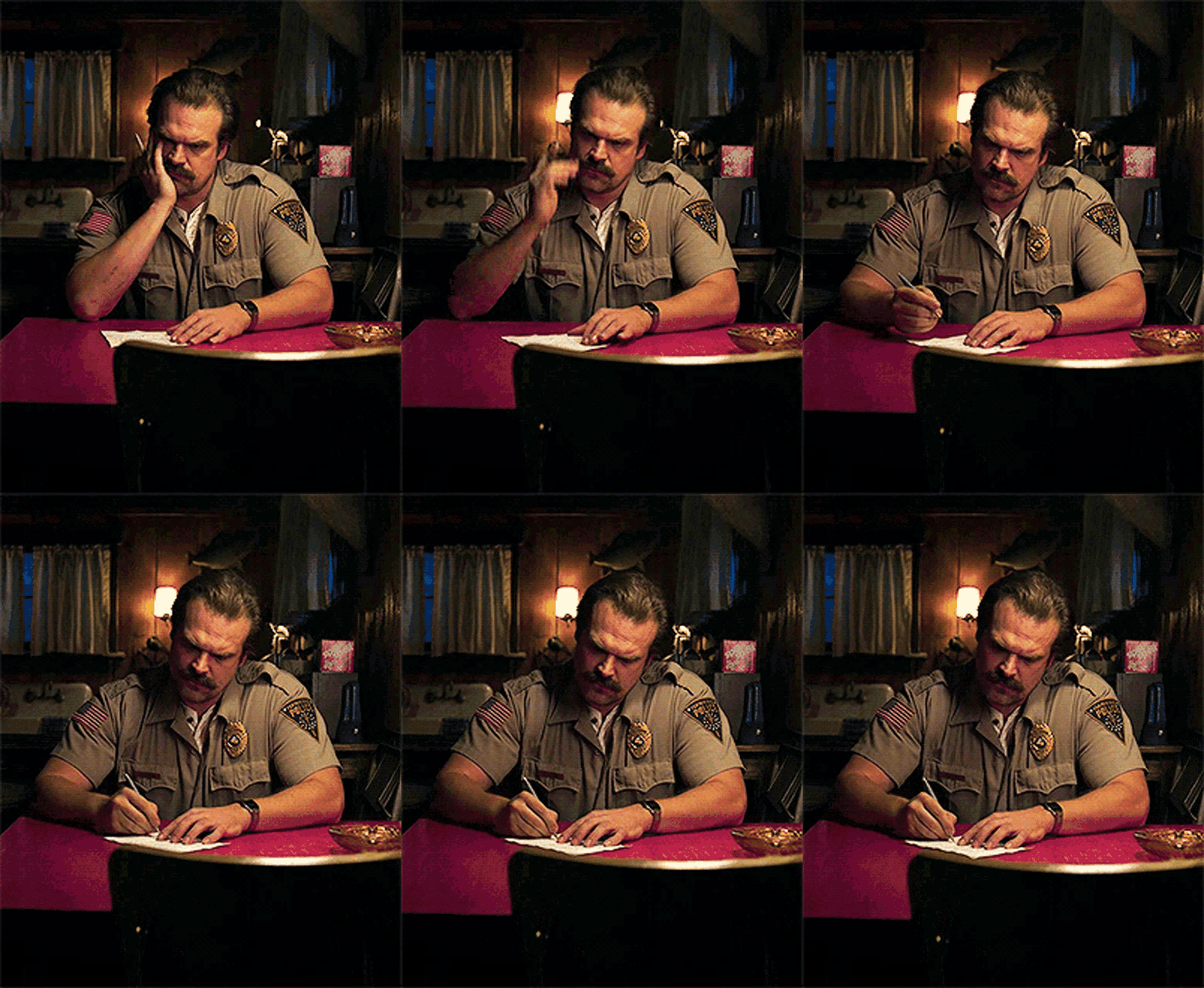
Getting your time to work for you

Most of this week for me has been splitting time among a few projects, with notable progress on each. Especially notable was that two of them had felt somewhat stalled, so to have broken through that wall and kept going was quite the endorphin rush.

Since I was feeling rather accomplished about this relatively minor feat, I put out on social media how nice it was to have done so. A number of writing associates offered up congrats and encouragement, as well as one person who asked “How do you find the time to do all this?”

I’ve gotten this question before.

How DO I find the time? How does any writer?

I guess the simple answer is: I make the time, whenever I can.

Some writers are able to have a designated window of when they work. Maybe they wake up a little earlier than they need to and write for an hour or two before they need to get ready for the day job.

Or they have mini writing sprints at the day job; 10 minutes here or there, during the second cup of coffee or lunch, what have you.

Or maybe they wrap up their day with writing before going to bed.

It really depends on what works best for you.

As much as I’d love to have a big block of time each day to be all about the writing, some days that just isn’t possible, so I make do. I have a little downtime during the day job, so I try to squeeze something in when possible.

But I’m also trying to get in better shape, so a certain amount of my day might involve an hour-plus at the gym or going out for a run. This in turn means I’d have less time to write, but if I don’t exercise, I’ll feel lousy mentally and physically, which in turn won’t help me be productive for the writing. If that means a slight extension of how long it takes to finish a project, I’m okay with that.

(One exception – if I’m on a deadline, all bets are off and it’s all about the writing.)

Sometimes it’s not about how much time I have to write, but how much I plan to write in that time. More than once I’ve sat down thinking “I want to write at least three pages today.” If I write three, great. A lot of the time I’ll push myself to do at least a little more, depending on how productive I’m feeling. Anything beyond the original objective is a bonus.

It’s all about setting up your own goals and expectations. Be realistic. What do you think you can accomplish each day with the time you have to work with? You know better than anybody how you operate, so plan accordingly. Write for an hour and see how far you get? Set an achievable goal (the aforementioned three pages) and see how it goes?

It’s easy to feel negative when you see other writers proclaiming things like “Woo-hoo! Another dozen pages done today!”, and all you could manage was two or three.

Don’t. Everybody runs at their own pace. Like I remind myself when I take part in a race:

It’s the distance, not the time.

It’s more important to do this – and finish – on your own terms, rather than pushing yourself too much and running yourself ragged, resulting in collapse and/or burnout. And I’m not just talking about running.

Know what you want to accomplish, and knowing how much time you have to do it, you can plan accordingly.

Repeat as long as necessary until the damned thing’s finished.

Until the next draft, where you go back and find the time to do it all over again.

Reinforcing the shoestring

For those unaware, I had the good fortune last year to connect with a producer-director seeking a writer for their microbudget feature project.

After hearing their ideas and what they were looking for, I started developing the story, keeping them updated as things progressed at a decent clip.

One of the comments occasionally made during all this back-and-forth was, and I’m paraphrasing here – “Is there a way to cut the costs on that?” Since this is a micro-budget project, it’s imperative we get as much out of every dollar as possible.

Thus the changes and alterations began. A scene originally intended for a hospital room now takes place in somebody’s bedroom. A scene in a restaurant now has the two characters drinking to-go coffee and talking on a park bench.

You get the idea.

As the writer, it can be a bit of a challenge to revise a scene or sequence to accommodate the budget, but it also forces you to dig deeper into that creativity and come up with a solution that works just as effectively, if not more so.

If this were a regular spec, working within a budget wouldn’t be an issue. I’d just write whatever worked for the story. But if that script got picked up and the producer needed changes made, then they would be made.

Looking over some of the revisions, I also realized that some scenes could pack even more of a punch by utilizing sound and lighting (or lack thereof) for emphasis, rather than on just what we see. Leaving things to the imagination – what you hear and don’t see – has the potential to be much more effective.

(For a strong example of this, check out the 1942 classic horror-thriller CAT PEOPLE.)

Taking this “less is more” approach also helped with resolving a story problem in a significant way. A sequence that would already have been challenging to make is now drastically different but would be very simple to pull off, and we’re both very enthusiastic about how the end result would look.

While some aspects of the story and how it’s presented may have changed, the tone remains the same. There’s still a ways to go with the script, but writing it with this kind of mindset helps me figure things out so the story is just as compelling while also getting the most bang for the buck.

The heart of the matter

The past few weeks, part of my writing schedule has involved revising the outline of my animated fantasy-comedy spec. It’s been fun to develop – having a previous draft to work with really helps. The action sequences, the story, the jokes and sight gags haven’t been too difficult, but I’ve been making more of an effort to build up the emotional aspect.

This isn’t to say I’ve never included that. It just hasn’t been as prevalent in the early stages of planning and plotting process.

It’s not enough to just show the stuff that’s happening, you need to show how it’s relevant to the characters. While the plot is about the external goal (what do they want?), there’s also the importance of establishing their internal goal (what do they need?).

Sometimes the internal and external goals work together, and sometimes a character will achieve one and not the other. There’s also the tried and true “they got what they wanted, but it wasn’t what they needed” (and vice versa). It all depends on how the writer wants to the story to go.

To help myself get a better grasp of this, I’ve been reading the scripts for and watching other animated films to see how they approach it. There has also been the occasional “read a few pages of the script, then watch how it plays out onscreen”.

*helpful tip – for prime examples of incorporating emotion into story, you can’t go wrong with well-made animated films. They do a fantastic job of setting everything up as fast and efficiently as possible. Sometimes singing is involved. And as it should be with live-action, each scene manages to include advancing the characters’ emotional arc as well as the story arc.

As more than a few readers have said to me, sometimes my writing is more about what we see onscreen and not as much about what’s happening to the characters on the inside. Hopefully that won’t be the case this time around. Since I’m still outlining the story, I try to include what the emotional impact is in each scene. Does the point of the scene affect the character(s) the way it’s supposed to?

At first, this was pretty challenging, but watching how other films accomplished it, it wasn’t as daunting as I initially thought, plus the more I think about it and plan for it, it’s not as bad as I thought. It’s helping with the overall development because I’m taking that sort of detail into consideration as part of the initial planning stages, as opposed to trying to work it in later, along with avoiding a few unnecessary rewrites.

Since this is a slightly different approach for me, I’m sure it’ll be chock-full of trial and error along the way, but am fairly confident it’ll yield the results I’m hoping for.

(you + ideas) x plan = 2022

As we stand on the cusp of a brand spanking new year, do you know what you want to accomplish, writing-wise?

More importantly, do you have a plan on how that’s going to happen?

I’m finding that it really helps to take a realistic approach, focusing more on the things we can actually control, rather than the things we would like to happen.

Knowing your own productivity and output, how many scripts do you think you could write/rewrite?

For me, I’m looking at 1-2 new ones, and 2-3 rewrites. Might be a bit of a challenge, but still doable.

I’ve also noticed an increase across social media of writers offering to give notes to other writers, so that’s something also easily achievable. Doing that once or twice a month benefits both you and the other writer, and a lot of the time the other writer will reciprocate, so…win-win.

Lots of writers are also directors or filmmakers, so maybe making a film or a short is part of your 2022 to-do list. Count me among that number. Got a horror-comedy short I’m just itching to make, and have started the ball rolling to see that happen.

No matter what you’re hoping to accomplish this year, I hope you not only do that, but also manage to enjoy yourself along the way. You should be getting as much out of the journey as you do finishing it.

And keep in mind that while you might be flying solo on a project, you’re definitely not alone. Just about every other writer out there is going through the exact same thing. Don’t hesitate to ask for help, advice, or feedback, or to offer it.

Win-win, remember?

Here’s to a phenomenally productive 2022.

The spark is lit once again

I hadn’t realized it had been quite a while since I’ve written about how my writing has been going, mostly because there hasn’t been as much of it as I was hoping, and what there has has been proving to be a bit of a challenge. Therefore…

The past few months have been me working on rewriting/overhauling the fantasy-comedy I wrote last year. For some reason, it just wasn’t clicking for me, hence the lengthy break.

So when I decided the time was right to dive back in, I really had to figure out what the problem was.

I still loved the concept, and a lot of what I’d already written, but something still seemed off. So I went to my tried-and-true practice of “take a step back for a closer look”.

What was it I liked about the story? Did the way it played out seem like the best way to tell it? What could be done differently, yet still yield the same results (or something even better)?

When I was first putting the story together, I must have gone through at least half a dozen different ways to start it. Each one had it’s own pros and cons. I don’t strictly adhere to “this plot point HAS to happen on THIS PAGE”, but I do what I can to stay in the neighborhood.

As I wrote down scenes I wanted to include, a pattern started to emerge. If I started the story THIS WAY, that would lead to THIS happening, and maybe I could rearrange a few things so as to get the full impact of what I was going for.

Then another realization came to me. The story was working, but my protagonist was the wrong character. Another character initially created as a big supporting role seemed to hold more potential, plus having things revolve around them would really punch up the tone of the story.

More pieces of the puzzle were falling into place.

Because of this drastically new approach, I don’t have the option of just recycling scenes from the previous draft. Each scene has to be rewritten to accommodate this new perspective and really play up the impact this new protagonist has on everything around them.

It’s a challenge, but the new story is slowly coming together. My enthusiasm for putting myself through all of this and my confidence in the story is as strong as ever.

I’ll admit this is also taking longer to than I wanted it to. My initial hope was to have completed the outline a while ago and have a new draft done by the end of the year, but that ain’t gonna happen.

Instead, I’m totally fine with the rest of 2021 being all about hammering out the outline and its subsequent fine-tuning. Kicking off the New Year with pages isn’t a bad way to go.

As we head into the weekend, here’s hoping for a whole lot of productivity for everybody’s current projects.