Plan accordingly forwardly

mountain climber
Know what’s ahead and what you’re going to do about it

Now that we’re well into the second half of the year, I’ve been working on scheduling out how I’d like the time between now and December 31st to be filled up, both writing and career development-wise.

As you’d imagine, there’s a lot of writing involved. Finishing the rewrite of one script, polishing another, cranking out a first draft of yet another. I’ve done what I can to establish realistic and achievable deadlines – no more writing marathons for me.

Add to that the efforts to network and meet with other writers, both in-person and online, along with pursuing viable avenues to get the work out there, such as query letters and contests.

One important part of all of this is that, for the most part, I’m the one overseeing all of this. Nothing will get done or happen if I don’t make the effort. As for the things I have no control over, especially the career-oriented ones, I’ll do what I can to get the ball rolling and see what develops.

A friend saw my list of objectives and said “Good idea. Plan to succeed.”

Part of this stems from exactly that. I’m working at this so I can succeed. Being organized about what you want to accomplish helps you stay focused on getting closer to actually achieving it.

While you’re working on your script, you should always be asking yourself “How can I make this better?” Well, this also applies to working on getting a career going. How can you make it better?

Keep writing. Your skills will improve and your number of completed projects will increase.

Seek out connections. The internet is your greatest tool for networking with other writers and folks within the industry. Very important – be nice.

Do your homework. Find out the necessary details as they apply to you and what you’re trying to accomplish. Whether it’s the best format for a query, if somebody’s contact info is still accurate, or which contest is a good match for your script.

Commit. You know all the things you need to do and want to do. Now dedicate yourself to doing them.

All of this may seem somewhat overwhelming at first, but get in the habit of making it a daily effort – even just a little at a time – and the results will start to take shape.

One scene, three points

trident
Careful not to get stuck on any of them

After some thorough self-imposed analysis, the revising of the comedy spec is underway. It’s getting easier to spot trouble spots.

There’s one scene in particular that’s giving me some trouble. It’s a pivotal scene involving the main character and offers a revealing glimpse into his backstory. The problem was in figuring out how to best do that.

After much drumming of fingers, rubbing of chin, and a whole lot of attempts, a potential solution may have presented itself. It’s still in the development phase, but for now, quite workable.

One of the first things I learned about screenwriting was what each scene needs to accomplish:  advance the plot, the character, and the theme.

Regarding plot, does the scene move things forward? Does it fall neatly into place in terms of how the overall sequence of events plays out? If you took it out, would it totally mess things up?

I’ve read a lot of scripts where something happens and I don’t know why. Maybe it’ll pay off later? Sometimes it does. Other times, well…

Another handy tip when it comes to advancing the plot in a scene: do it quickly. Get to the point of the scene as fast as you can, then get out. Don’t wait around. Just get out now. Too many times I’ve seen a scene drag on much, much longer than it needs to.

Regarding character, does each scene show them changing a little bit more from when they were first introduced? This doesn’t just apply to the main character. Every character needs to grow/develop. Wouldn’t it be kind of boring to read a story where nobody changes?

And tying it into the advancement of plot, every situation the character experiences should help move their own development along.

Which brings us to theme. The message of your story. This can be a little tricky.

Each scene should tie into the theme, or have it on display in some manner. I recently worked with a writer having trouble tying everything together. We discussed the story and the main character’s internal and external goals. What was the message they wanted to convey? Based on those discussions, we were able to come up with a theme that worked for both the story and as it applied to all of the characters.

One of my favorite examples of a theme in use is BACK TO THE FUTURE. Early on, Marty says “History’s going to change.” And boy, does it. We get a ton of set-up in the first act, and then everything does indeed change in the second act as all of those setups are paid off. Amazing.

Take a look at your latest draft. Does each scene advance the topics in question? If not, do you have a way to fix that so it does? The more you get in the habit of doing this, the easier it’ll get and the faster it’ll become second nature to do it all the time.

Time for the editor to take over

editor
Where’s the ‘delete’ key on this thing?

The latest undertaking: the edit/rewrite of the low-budget comedy spec is underway.

Even while I was writing it, I knew there were changes that needed to be made. So now it’s time to dive in and make those changes, which tends to be equally as thrilling as the actual writing process. For me, anyway.

This is the part where I force myself to let those changes be made, even for the parts I absolutely love. There will most likely be more than one instance of “Why did I think this was a good idea?” Then I change it.

It happens with every draft of every script. You have to be able to be your own harshest critic. Every decision stems from “How can this be better?”

Sometimes it comes easy, and sometimes it doesn’t. It takes a while to get the hang of it.

“But why not just do it while you’re writing that initial draft?” some may ask. Because you don’t always hit the bullseye on your first attempt. You need a couple of practice tries. Many’s the time I’d suddenly stumble into a solution that proved to be significantly better than the original.

Don’t hold back. Don’t be afraid to make those changes. As I’ve discovered many times in the past, once something is changed, it is very soon forgotten. So much to the point that you’ll barely remember the previous incarnation.

When this whole process is done, at least for this round, I believe the end result will be a better script. I’m fairly confident this won’t take too long, and think writer-me will be quite content with the decisions made and steps taken by editor-me.

And then the whole thing will repeat itself again.

*Side note – blogger-me is proud to announce that the number of visitors to the blog has surpassed the 20-thousand mark. Not too shabby, especially considering the first few years were me and about six other people.

Thanks for reading, everybody!

Subtle tweaks

I would totally use this

Had a really good phone call with my manager and his assistant yesterday (still getting used to being able to say that) about what changes need to be made to the script before it’s ready to go out.

Fortunately, there aren’t that many.

Most of them are small details that will add a little depth to the story and flesh out some of the characters. Looking over the notes doesn’t make it seem like it’ll be too big to tackle.

It’s always nice to hear somebody be as enthusiastic about your work as you feel when you’re working on it. A little validation goes a long way.

I was really impressed with Chris the assistant’s knowledge about crafting a script and what makes for a good story.  He definitely knows his stuff.  It didn’t hurt that he seemed especially interested in some of my other story ideas.

So for now the focus is on the rewrite. The first draft of the western is on hold (54 pages as of yesterday), and the podcast gets pushed back again.

It’s highly doubtful all my potential script meetings/discussions in the future will go this smoothly, but it was definitely a great way to start.

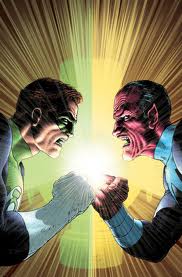
The Sinestro Effect -OR- Seeking my inner Hal Jordan

Not necessarily my internal struggle, but you get the idea...
Not necessarily my internal struggle, but you get the idea…

(If you have absolutely no idea who either of these guys are, go here.)

The rewrite’s done, and all of a sudden, I’m nervous. Like, ridiculously so.

I’ve sent scripts out before, but this time something is making it a lot different.

A fear of failure.  Of rejection.

What if nobody likes it?

What writer hasn’t gone through this?

But as I tell K every once in a while – the only way I could fail is if I stopped trying, and I don’t plan on doing that either.

It may be that after all this time, the idea of possibly being that much closer to actually achieving my goal is kind of overwhelming.  This is where that internal voice kicks in.

Do I have what it takes? Is the script just about ready to be sent out?

Damn straight. I’ve got a lot of confidence in this script and my writing ability.

I can and will do what it takes to make this work.