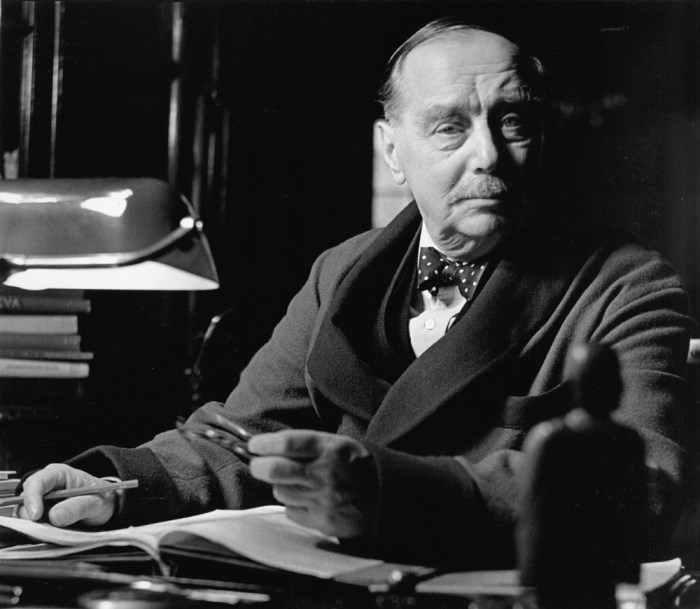
No small feat using another medium to be a writer-at-large

HG Wells
The man responsible for tales of time travel, alien invasions, and assorted mad scientists, just to name a few…

After a gap of several years, I recently had the opportunity to reconnect in person with a respected colleague who has had more than their fair share of experience dealing with writers of all shapes, sizes, and levels of talent.

This person used to deal a lot with screenwriters, but now deals primarily with writers of manuscripts. Over the course of our conversation, I was asked about my scripts and my writing (What do I like to write? What genres are the scripts I have now? What kind of stories am I working on?)

As has been documented here before, my genre of choice is definitely adventure, along with hyphens connecting them to other genres (i.e. western-adventure, pulp sci-fi adventure, etc).

I gave a quick thumbnail sketch/five-second elevator pitch for the two completed and the one currently in revision mode.

You’d be harder pressed to find a stronger advocate for using your already-existing material as a springboard to jump into other mediums – primarily books and/or graphic novels.

It was their opinion that all three sounded like very original and fun ideas, which would make each a prime candidate for attracting attention. And this person has also been following the blog for quite a while, so their opinion is also that my writing is pretty solid. They cited examples of writers they knew who’d foregone the traditional route of trying to get in with one of the high-profile publishing houses and done it all themselves, each achieving respectable levels of success. Nothing to break the bank, but still some impressive numbers.

“A script is more or less an outline for a novel. And even though you’re not limited by page numbers, it still takes talent to create a novel,” I was told. “Your stories are original and unique, which makes them prime candidates for this. At least think about it.”

Believe me, I am.

My success in trying to get these scripts through to reps and production companies has been practically non-existent at best, yet I persist. I’m sure I’ll continue along that avenue, but this new alternative is definitely food for thought.

I’ve been told by more than a few people that my writing is very visual (which you would think would make it ideal for film), and that it really moves. In the past, I’ve entertained and even at times partially investigated the notion of applying my scripts to a graphic novel format (a great match), but am also not averse to trying my hand at converting it to pure prose.

I’ve no intention of stopping writing scripts. I like it too much. But I also like the pure act of writing by itself, so for the time being, all this talk about working in other formats is nothing more than speculation and conjecture.

But in some ways, still worth considering.

Start with similar, venture into different

path
With one you can play it safe, while the other offers up more of a challenge

In the handful of times I’ve helped out as co-writer or script polisher on somebody else’s project, there have been variations on the following conversation:

ME: And then THIS happens!

THEM: Oh, we can’t do that. ACTUAL MOVIE did the same thing.

ME: Not exactly. ACTUAL MOVIE did THIS, and what I’m suggesting is maybe at the very foundation the same concept, but if we did it THIS WAY so THIS HAPPENS, it would be entirely different.

THEM: But won’t people think we’re just ripping off ACTUAL MOVIE?

ME: First of all, ACTUAL MOVIE has been out for a while, and you’re at least a year away from having this thing done, so I highly doubt the first thing anyone’s going to think is we’re ripping off ACTUAL MOVIE. Second, this is exactly why I think THIS is how it should happen. True, both use the basic concept, but we’re putting our own spin on it so it doesn’t resemble ACTUAL MOVIE at all. They’re similar, if you could even call it that, but still different.

THEM: (thinks it over). Well, okay. We’ll give it a try.

And…scene.

I’ve read about this in articles and seen it firsthand while reading scripts, both times usually associated with newer writers. Somebody really likes how something happens in a film or a script, so then they go and have the EXACT SAME THING happen in theirs. I get that you liked that original, but why, oh why would you want to use it practically verbatim in yours?

Doing the screenwriting equivalent of a “copy, cut, and paste” will do you no good because it’ll be painfully obvious that’s what you did. You’re trying to tell an original story, and THIS is what you do?

If anything, people will definitely think you ripped off that original thing and berate you for your total lack of originality. Was that your goal? Probably not.

Time to get analytical. What was it about that particular something that really got to you? Why do you feel the need to have the same thing happen in your script? That’s the angle from which to approach it.

But this is also where the challenge begins. Once you identify that core detail, it’s up to you, the writer, to figure out a new way to use it in such a way that not only does it serve the purpose you need, but also pays homage to what inspired it in the first place.

You know where things are going, or at least where you want them to go, but now you need to tweak how they get there. Work those muscles of creativeness! Try something new! Don’t hesitate to jump off the beaten path into new territory! If anything, you might come up with an entirely new idea that accomplishes exactly what you needed, but just a totally different way.

Sure, there’s a very slight chance it could potentially remind somebody of ACTUAL MOVIE, but they’ll definitely remember that it came from yours.