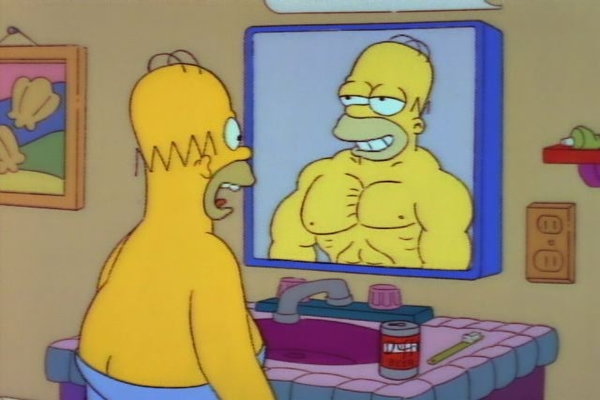
Behold my awesomeness!

homer
A little ego indeed goes a long, long way

Time now for a question I’ve been pondering quite a bit lately:

When talking about yourself and your accomplishments, how much is too much?

Yes, you should be very proud of whatever success you’ve achieved. You want to have confidence in your writing and your abilities, but you also have to be careful about overdoing it.

It’s a fine line between “My script made it to the Nicholl semis! Yay!” and “My script made it to the Nicholl semis. Am I not amazing?”

Then there are the writers who continuously mention their success (“That reminds me of when I was working on my PAGE Silver-winning script…”), or even worse, exaggerate. I’ve read of a writer who touts having won a prestigious contest, when the truth is they won for their genre, not the overall grand prize. Two very different things.

Some people tend to forget that claims can easily be verified on the internet. So don’t lie, unless you enjoy the truth coming back to bite you on the ass.

I’ve had dealings with writers and directors who would rattle off their accomplishments without any prompting whatsoever, including one filmmaker who, during a 45-minute conversation, mentioned at least three times the fact he’d made three films and two mentions of how an A-list actor was interested in one of his scripts (a claim now several years old, and as far as I know, nothing has yet to come from it).

Counter to that, I’ve read updates from writers who, despite their success, remain relatively tight-lipped (“Sold a script today. Looking forward to working with ____ on it.” And that’s it.). I can appreciate that. You’ve said what you wanted to say, left it at that, and moved on.

Speaking for myself, I opt to keep quiet. If somebody asks, I’ll mention having some moderate contest success, but prefer to not be the instigator. I don’t mind tooting my own horn, but I don’t want it to drown out the rest of the conversation.
The Force is strong with this one

galaxy
Don’t get your knickers in a twist. This isn’t about that.

Star Wars: Episode VII officially opens today, and my God, what an impact this is having. I’ve been a fan since way back in ’77, but not to the point of sleeping in front of a movie theatre for days on end.

I’m opting to wait a couple of days and let all the crazy hoopla die down. It’s not like it’ll play for a week and disappear. Even the neighborhood theatre up the street is playing it on both screens. That’s saying something.

Looking at this phenomenon from a screenwriting point of view, you can’t help but be impressed with the world that’s been created here. Count me among those inspired by the creativity on display in these films and who strive to achieve something similar with our own work.

I’ve written before how I’d love to write the next STAR WARS (as would a zillion other writers), but I don’t mean a sprawling epic space opera, although that would be kind of cool.

I’m talking about an entertaining story of memorable characters and situations that you never get tired of seeing. That thrills you with its overwhelming sense of wonder. The sheer joy of being swept away as this tale unfolds before your eyes and ears.

Do I have that ability? Hard to say, but I like to think so. Nobody thought STAR WARS was going to do well, and you know how that worked out.

So in the meantime, I’ll keep plugging away, telling my own stories the best way I can, and hope that someday I come close to accomplishing something similar. At the very least, it’ll be fun trying.

See you at the movies.


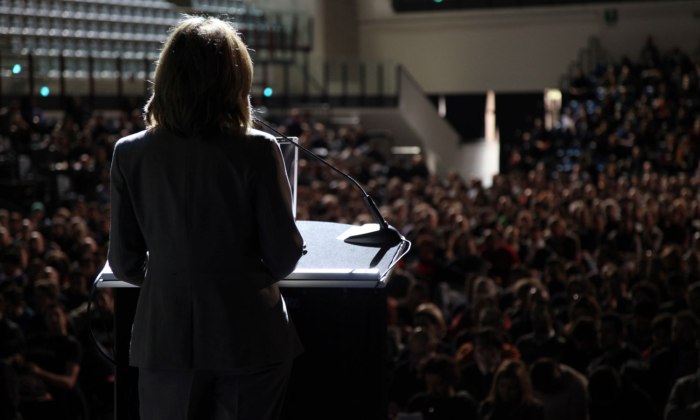
How’s it going?

public speaking
Go ahead. You’re among friends.

From what I’ve been reading on the internets, a lot of you are making some excellent progress with both your writing and your careers.

I’d love to hear more. Feel free to share the latest development(s) for you and/or your writing. Anything worth noting you’d like to tell the world? Doesn’t matter if you’ve made a sale or written 2 pages in your latest draft. It’s all good stuff.

I’ll go first.

I’m about halfway through outlining the story for a sci-fi side project, working on some script notes for a few friends, still trying to break the story for my new idea, and my western has advanced to the semifinals of the 2015 Screenwriting Action/Thriller contest.

See? Nothing to it.

Your turn.

A few points about plot points

delorean

Time for a quick refresher course, chums.

Today’s topic: plot points. What they are and what they represent.

I’ve always seen plot points as pivotal moments in the story; events that change the situation for your protagonist, usually in a negative manner, and ask/reiterate the central question (Will your hero achieve their goal?).

Having solid plot points also helps establish your story’s structure. Without it, all you’ve got is a big convoluted mess, and who wants to read that?

Although this uses a 110-page script as an example, plot points don’t have to happen exactly at those pages. A few more or less is totally acceptable. I’ve also opted to use fairly recognizable examples to emphasize each plot point.

Pencils ready? Let’s begin.

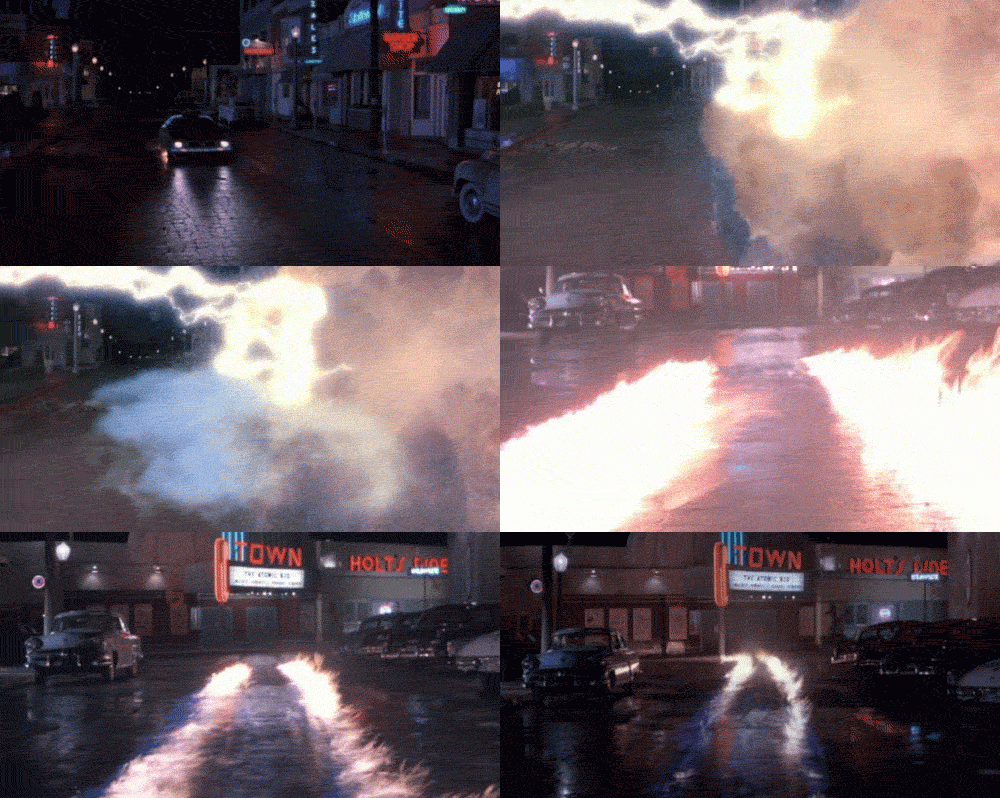
Page 3 – statement of theme. What’s the overall message of your story? The theme should also be incorporated in some fashion into each scene throughout the course of the story. (“No McFly in the history of Hill Valley has ever amounted to anything!” “Yeah, well, history’s gonna change.”)

Page 10 – inciting incident. The event that shakes up you protagonist’s world, and asks the central question of the story. (Will Indy get the Ark before the Nazis?)

Page 17 – a twist to further complicate things for the protagonist. (“Alderaan? I can’t go with you to Alderaan!”)

End of Act One (page 25-30) – Your protagonist leaves behind their old world and enters a new one to achieve their goal. Also repeats the central question. (Marty arrives in 1955)

Page 45 – another twist to complicate things for the protagonist (Indy saves Marion, destroys her bar. “I’m your goddamned partner!”)

Midpoint/Point of No Return (page 55-60) – your protagonist becomes fully committed to achieving their goal (Brody decides to go after the shark after his son barely survives the latest attack)

Page 75 – yet another twist to really complicate things for your protagonist (Vader kills Ben as Luke & Co escape)

End of Act Two (page 90) – All is lost. Your protagonist is totally screwed with no apparent way out. Makes it seem like the answer to your central question is “no”. (The Nazis get the Ark).

Climax (page 95-100) – final showdown between your protagonist and antagonist. (Rebels attack the Death Star. Marty must hit the wire when the lightning hits. Nazis open the Ark. The shark attacks the Orca, eats Quint.)

Resolution (page 100-105) – Aftermath of the climax. Central question gets answered. (Rebels victorious. Marty returns to 1985. Brody & Hooper survive. Indy delivers the Ark.)

Denouement (page 105-110) – How your protagonist’s world is now different from what it used to be (but not necessarily better). (Marty’s family is successful. The Ark gets crated and goes into a warehouse. Luke & Han hailed as heroes. Brody doesn’t hate the water anymore.)

So there you have it. Do the plot points of your story match up with these? Just something to think about. And feel free to watch the movies represented here (or one of your own personal favorites, or one similar to yours) to see all those plot points in action.

It just might be some of the most fun homework you’ll ever have.

Being a blast from their past

corner
Hi. Remember me?

Earlier this year, I attended the Great American PitchFest, where in addition to fine-tuning my pitching skills, made some great personal and professional contacts.

Among the latter was a production company who was very interested in my fantasy-adventure. They ultimately passed, not because the script wasn’t for them, but because they’d found another project.

At the end of that email, they included the offer for me to stay in touch. This was in June.

Jump ahead a few months to last week. Sorting through old emails, I’d found that one and figured now was as good a time as any to reconnect. I sent a brief note reminding them who I was, asking about that other project, and if they were still interested in my script.

They remembered me, the other one was progressing nicely, and they definitely were.

A few days later, I had a very pleasant hour-long phone call with one of the partners (the other had a last-minute scheduling problem). We discussed my script, some of their other projects and a few related and not-related topics.

The call ended with them wanting to continue the conversation after the holidays, making sure the other partner would be on hand.

Will anything come of this? I don’t know, but for now, it’s very encouraging. Am I glad I sent that follow-up email? Damn straight.

Sometimes it feels as if the door gets totally slammed shut in your face, but there’s a chance they might leave it open for you just a little bit – enough for you to take advantage of it somewhere down the line.

Who wouldn’t rather have someone say “It’s not for us, but stay in touch” instead of just “Thanks, but no thanks”?

If you do get that open invitation, make the most of that time by working on something else. Your initial project may have gotten their attention or piqued their interest, so this way you can redirect all that nervous energy into your writing and be ready if they ask “What else have you got?” in that second go-round.

Be patient. And courteous. And respectful. A lot of these folks are working just as hard on their own projects as you are on yours. The last thing they need is dealing with a pushy writer bombarding them with emails.