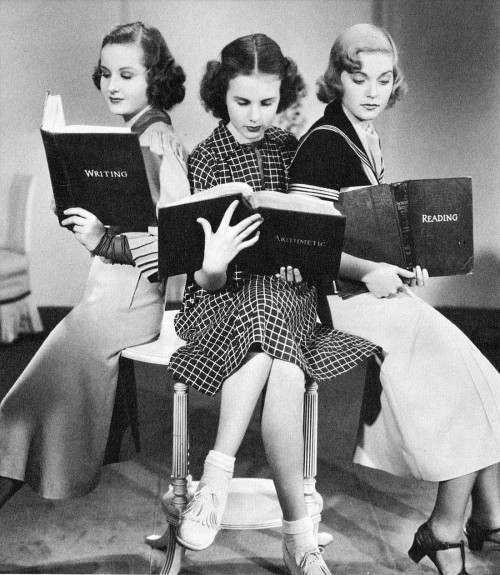
Educate thyself

reading 2
Quiet, please. Writers at work.

Chances are you came to this blog/post via a link from an online screenwriting group or forum. (If you’re a first-timer – welcome! Feel free to subscribe.)

When time permits, I’ll browse through some of the groups to check out what kinds of subjects and topics are being discussed. There are also questions. A LOT of questions. Those can range from “How do I get an agent?” to “What’s the proper format for this?” to “How do these pages look?”, all of which will yield a wide variety of answers.

I don’t usually comment because most of the time I come into it late and somebody with just as much if not more experience than me has already said what I was going to say.

There was a recent post where somebody asked what the best screenwriting book was. Answers ranged from several well-known titles to “read scripts instead”.

To a certain extent, I think those are both good answers. The books that helped me the most were Dave Trottier’s The Screenwriting Bible, primarily in terms of getting a good handle on formatting and the basics of structure, and Paul Lucey’s Story Sense, which expanded on both (and appears to be out of print, but still worth tracking down a copy.)

While some books might help you get a grasp of the basics, the real learning comes from immersing yourself in reading scripts and working on your own. Another helpful practice is to watch a film with the script in hand, following along with the action onscreen while seeing how it’s written on the page.

Reading a script can really help show you what should and shouldn’t be there, which you can then apply to yours.

This doesn’t just apply if you’re just starting out. I still get a kick out of reading scripts, whether it’s from the Black List, or one somebody recommended, or even when someone asks me for notes. Bonus points if it’s somebody within my network of writing colleagues; I know they can deliver the goods, and that’ll be reflected in their script.

I’ve also seen my fair share of terrible scripts, usually identified as such by the content of the first page. If that’s not good, there’s little hope of improvement for the rest of it. The silver lining here is you will quickly see how NOT to do it, thereby ensuring you won’t duplicate it.

So while you should definitely devote time to writing your script, make sure you set some time aside to read scripts. You’ll be entertained AND learn at the same time.

-Filmmaker/script consultant/friend of the blog Jimmy George is offering a special limited-time discount for first-time clients – 50% off all script services. No matter what you’re working on, whether it’s a feature, a short, or TV, Jimmy’s ready to help you out. But better hurry – the offer’s only good until October 11th.
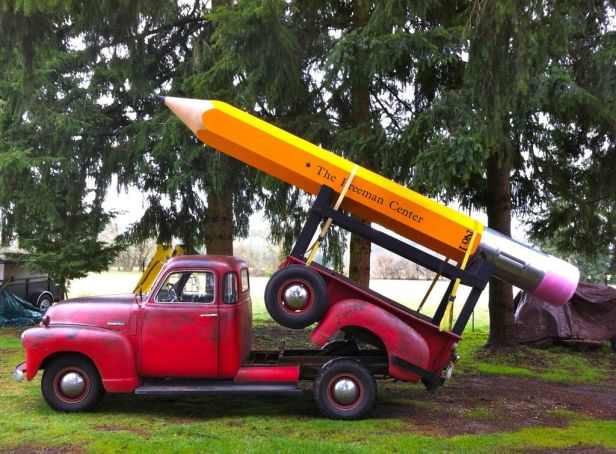
More than just a pencil?

giant pencil
It wasn’t THAT big

Now that we’re in the month of October, what happened to me this morning feels very apropos for the season, and definitely worth recounting.

But first, a little backstory…

The latest draft of the pulp sci-fi is just about wrapped up. I’ve received lots of great notes on it, and incorporated some very helpful suggestions. The contest I’d like to send it to has its final deadline next week, so the past few weeks have been all about getting it as ready as I can.

While I still plan on submitting this script, there’s still that part of me that isn’t sure if it’s good enough, and that maybe I should hold off on the contest because it just needs too much work, which of course makes me doubt my abilities as a writer.

“Am I good enough? Am I wasting my time?” You know. The usual.

Cut to this morning.

My workday starts at 5AM, which means I get up around 3:15. Part of my getting ready involves having to take the dog out.

Since we live near Golden Gate Park, there’s always a chance of running into raccoons or skunks, so I’ve started bringing a flashlight as part of the dog-walking.

This morning, we got to the bottom of our front steps, and right there just beyond the first step was a pencil. Just a plain ol’ regular pencil.

I thought that was kind of weird. How did a pencil get there? Maybe one of the neighbor kids dropped it yesterday as they passed by? But it wasn’t there last night when I took the dog out. I took the dog around the corner. She took care of business, and we returned home. The pencil was still there.

We got inside and I got ready to head out to work. For some reason, I couldn’t stop thinking about the pencil. It being there seemed so random.

Maybe about seven, eight minutes pass between returning inside with the dog and going down to the garage to get my bike ready (helmet, lights, etc). I step outside. Just out of curiosity, I want to see that pencil again.

I maneuver my bike over to the steps and reposition the headlight down towards the sidewalk.

No pencil. Swear to God. It was gone.

Let’s consider the possibilities:

-it wasn’t there to begin with. Maybe, but I distinctly remember seeing it just a few minutes ago.

-it wasn’t a pencil. Highly doubtful. The unmistakble yellow, the green metal, a pink eraser. Definitely a pencil.

-somebody took it. possible, but highly unlikely. Not a lot of foot traffic in our neighborhood at 4AM. K later suggested it was the paper delivery guy, but his m.o. is to  toss the paper from inside the car. Plus, we don’t get the paper anyway, so there’d be no reason for him to stop in front of our place.

-a raccoon or skunk took it. Again, highly unlikely, but you never know. They continuously go after our composting bin on the other side of the house, so why not snatch up a pencil?

And what may be the most outlandish theory of all – it was some kind of message to me.

Think about it. A pencil. The most basic of writing implements. Maybe this was some kind of “sign from beyond” that despite all my doubts and occasional lapses of self-confidence, writing really is what I’m meant to do and that I should keep at it.

Then again, I might find the pencil upon returning home later today, rendering the whole thing moot. (In which case, I’d wonder “How could I not see it earlier?”)

But pencil or no pencil, the message, or at least how I interpreted it, remains the same. Even with all the frustration, I’m in this for the long haul. There’ll be good days and bad days, but I’m hanging in there, determined to keep going.

Thus the pushing forward continues…

Guilty as charged

lardner mugshot
I did it. I’m glad I did it. And I’ll do it again. As many times as necessary.

The clock’s ticking down to the final deadline for an upcoming contest, so almost all of my energies are being directed at getting the pulp sci-fi in as tip-top shape as possible. Overall, I’d say it’s coming along nicely.

As you’d expect, there have already been some big changes made, with more than a few more on the way.

A major part of some of these changes has involved cutting material that I previously considered untouchable, or at least to do so would have constituted a crime against all that is good and wholesome.

Otherwise known as “killing one’s darlings”.

As you edit/polish/rewrite your scripts, changes will (and should) occur within the context of the story, so you have to deal with the consequences and ramifications of making those changes. And that means gettin’ rid of the stuff you love.

Did I really, really like this line of dialogue or that scene? Most definitely.

Did I cut it without a moment’s hesitation because it just didn’t work anymore? Yep.

Any regrets? Not really. Why should I? It’s all about making the script better, right?

A lot of writers won’t cut something because they hold it too close. To them, their ego takes precedence over the material. If a producer or director says something doesn’t work, and says it’ll have to be cut, what are they going to do? Say no?

It’s very rare that the final draft of a screenplay is exactly like the first draft. Changes will always be necessary, whether you want to make them or not. Much as you might hate it at the moment, make those changes. Chances are you’ll barely remember what was there before anyway.

A screenplay-in-progress is the raw material, and your job as the writer is to continuously work with it and shape it in order to get it to the final version – the one that tells your story in the best way possible.

If that means discarding something for something new, so be it. Even more so if the new something is even more effective.

Setting out in a new direction

hikers
Aha! Just the path we’ve been seeking!

As part of the overhaul of the comedy spec outline, I’ve been trying to come up with ways to make this draft significantly different from previous ones.

I’d managed to work my way through one of the subplots, and was now focusing on another one. But something felt very…off about it. It felt too preditable, in a tropey, tired cliche kind of way.

So of course, it had to be changed. But to what? That required a little more thought.

I tinkered around with a few ideas. Since this IS a comedy, what would be funny? That inspired some new trains of thought, with ongoing emphasis on “different”, “unique” and “original”. Finally, totally out of left field, one popped and stuck.

Boy, did it.

The more I thought about it and considered the possibilities, along with determining if it fit into the subplot and the overall storyline, the more it seemed to work. I honestly couldn’t recall seeing this idea in a script before.

Okay. This new idea creates a new objective for the storyline, so now it’s all about the “how things develop/how we get there”, PLUS figuring out how to present it in a way that’s original, unique, and funny.

Some more tinkering occurred, and it was all slowly coming together. There’s still some more work to do on this part and the rest of the script, and that’s totally cool.

The finished product will be significantly different from what it was before, and that’s really what this overhaul is all about.

Sometimes it can be tough for me to discard ideas and elements from previous drafts, but have found that totally wiping the slate clean and starting anew, or at least really pushing myself to come up with new ideas, is paying off much, much more than anticipated.

-Can’t let today go without acknowledging the ongoing and unwavering support I’ve received from the woman I’ve been extremely fortunate to be married to for the past 23 years as of this Sunday.

Writers – never, ever underestimate the importance of a partner who’s there for you through good times and bad. They are one of, if not your most valuable resource, and make sure they know how much you appreciate them.

Happy anniversary to my wonderful K. Love ya, baby.

Sums it up succinctly

bttf1
“Spaceman from Pluto”?*

While taking a break from working on the comedy spec this weekend, I took an unexpected dip into my file of “ideas in development” – scripts I plan on eventually writing.

One had more details to the bare-bones outline than I remember. In fact, I barely recall even writing it. Still, pretty impressive.

Another was just a logline and three potential titles. While the story really adheres to my ongoing attempt at trying to write material of a smaller nature (i.e. not as big-budget), what really stood out was those three titles and how different they were from each other.

The first stirred up a kind of noble nostalgia, and in retrospect might be better suited for another story.

The second was pretty generic; almost like something you’d see on a VHS copy of a mid-90s B-movie gathering dust on a lower shelf at your local video rental store. If you’re of a certain age, you totally get that reference.

The third was very reminscent of a certain genre and style of older films, and the final word in the title tells you what kind of story to expect. Such was the case here, but as much as I like the word, it wasn’t exactly the right fit for the story I wanted to tell.

Fortunately, the word in question has a lot of synonyms, and one in particular really jumped out at me. Some might consider it of a vulgar nature, but wow did it fit. In fact, as soon as it popped into my head, I actually laughed out loud, thinking “oh my gosh, this is PERFECT.”

Because not only is the new word an ideal fit for the story, but it really drives home the tone.

Although work on this script goes into the ever-growing pool of “future projects”, at least now the concept and story are a little more developed than they were. And any progress is good progress.

There can’t be enough emphasis on the importance of a strong title for your script. It’s the entry point for your reader. You want them to know what kind of story they’re getting, what to potentially expect, and most importantly, you want them to be excited about reading it.

Sometimes your initial title is good, but there’s nothing wrong with a little tinkering to find an even better one. Like your script, it can always do with a little rewriting.

*Universal Studios head Sid Sheinberg didn’t like the title “Back to the Future,” claiming nobody would see a movie with “future” in the title. In a memo to Zemeckis, Sheinberg suggested the title be changed to “Spaceman from Pluto,” and the title reference be worked into the film.

In response, Spielberg sent a memo back to Sheinberg, thanking him for sending his wonderful “joke memo” and that the office “got a kick out of it.” Embarrassed, Sheinberg let Zemeckis and Spielberg keep the film’s original title.