Advice, suggestions, and everything in between

neil-gaiman
“When someone tells you it isn’t working – they’re almost always right. When they tell you how to fix it – they’re almost always wrong.” – Neil Gaiman

Many, many years ago, when I was just starting out in radio, I’d put together a demo tape of some of my on-air material and asked some of the veteran DJs at the station if they’d give it a listen.

One guy had several positive things to say, but also pointed out ways of how I was demonstrating my still-green abilities. He made some suggestions about how to fix that, which would, in theory, help me get better. They did.

The second guy started with “It’s good, but here’s how I would do it.” I honestly don’t remember anything he said after that because I simply didn’t care how he would do it.

There’s a very similar approach to how one gives notes on a screenplay.

When I give notes, I read what’s on the page and offer up my opinions of how it could be potentially be improved (from my perspective). A lot of the time it involves questions like “Why is this happening?” or “How do we know that?”

Or if something doesn’t work, but I understand what the writer’s trying to do, I’ll ask “What if you tried THIS (different approach) that yields the same results?” They may not take that suggestion, but it might trigger something new and unexpected.

I totally get that this is their story, and my only interest is in helping them make it better. By asking questions that only the writer can answer, the responsibility of coming up with and applying any fixes falls squarely on their shoulders.

I also make a point of trying to be objective. I may not be a fan of your story’s genre, but that doesn’t mean I’ll automatically be negative in my notes. What I will do is approach it from a “does it tell a good story populated with interesting characters and situations?” perspective.

And then there are the notes that want to take your story in an entirely new direction. The ones that take it upon themselves to change your story because “that’s not how they would do it.” I’ve gotten quite a few of those.

But what if how you would do it is different than how I would?

Sometimes it’s a suggestion that runs counter to the story you’re trying to tell, or it might have absolutely nothing do with the story at all. I’ve even received the always-appealing “This was great, except for this one small thing I disagree with/don’t like, which ruined the rest of it for me.”

Everybody’s going to have their own opinion, but the one that counts the most is yours. Even if it doesn’t feel that way now, only you know what the script really needs, and you’re going to get all kinds of responses when you seek out feedback.

Some of it will be very helpful and insightful, some definitely won’t be, and in the end it’s really up to you to decide which notes you think provide the most guidance to helping make your script better, which will in turn help you become a better writer.

 

For crying out loud, DO SOMETHING!

bored
Is THIS how you want your audience to react?
While the November writing project moves forward at a pleasant pace (but now appears to be more of a November-December thing), part of my time has also been spent giving notes on some friends’ scripts.

One in particular had a few problems, some of which were easily fixed, but what really stood out was how it committed a cardinal sin of screenwriting by having a lot of scenes where the characters talk repeatedly about something “important” they want to do, but by the end, they end up not doing anything. And I mean that literally. These were some of the most passive characters I’ve experienced.

It didn’t help that the characters also had no arc. They were exactly the same from beginning to end (with maybe the exception of one who might have been arrested, but even the circumstances involved with that are still somewhat unclear).

Let’s face it. A main character who’s all talk, no action, and doesn’t change is the death knell for your script. Why would somebody be interested in seeing what happens to them, especially if they don’t do anything?

One of the most frequent problems I’ve seen is when the main character isn’t the one driving the story forward. They just kind of hang around and watch stuff happen.

Bo. Ring.

Remember, you’re trying to get your main character to their goal over the course of the story. They have to be the one making things happen in order to achieve that, or at least react to what happens in such a way that it helps them. The way these characters were written, I honestly had no idea what their individual goals were.

Take a look at your latest draft. Which character is moving the story forward? Is your main character active or passive? Are they making things happen? If not, can you see what you’d need to change in order to do that?

You definitely want your characters to come across as believably three-dimensional. Having them do little or next-to-nothing throughout the story is doing you no favors. Character motivation and actions are some of those key elements that simply cannot be left out. Audiences can forgive certain things, but a dull, passive main character isn’t one of them.

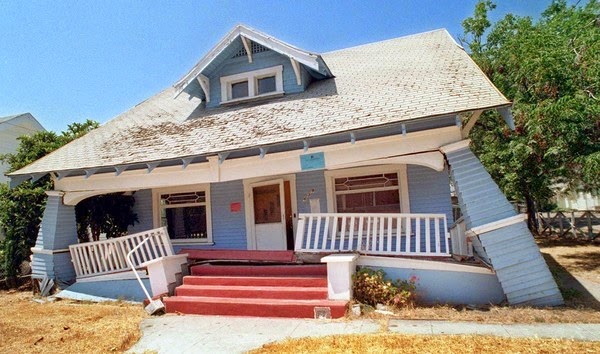
First, you build a solid foundation…

foundation
And this is what could happen if it isn’t

As the daily churning-out of pages continues for my November writing project, I’ve found it extremely helpful that so much time was spent working on the outline.

Only through trial-and-error did I eventually discover that making sure the outline is rock-solid before starting on pages makes a huge difference.

Keep in mind that this is what works for me. You may have an entirely different approach, and that’s totally cool. Actually, I’m curious to hear about some of them. Feel free to discuss in the comments section.

And now, back to the subject at hand…

I see putting together the outline as a gradual building-up process. I start with establishing the main plot points. What are the pivotal moments in this story? Does each one properly fulfill its purpose in the overall context of the story?

Then I fill in the blanks between those plot points. Does it make sense how we get from, say, the inciting incident to the end of the first act? Does each scene do its job in moving the story and characters forward? Are you presenting information we need to know, or setting things up so as to adequately pay them off later? Does each scene appropriately follow the one before and lead into the one after it?

Something important to keep in mind during this part: eliminating unnecessary scenes. You may have a scene you really, really like, but may not be absolutely vital to the story. My recommendation is to either make it vital or get rid of it entirely. The last thing you want is to interrupt the flow of your story for a scene that really doesn’t have to be in there.

Once you’ve got all those blanks filled in, then you move on to expanding each scene – mostly just putting in the necessary elements that reinforce the purpose of the scene. Sometimes I’ll add in a snippet or two of dialogue.

Another very important detail about each scene: get to the point, then get out and into the next one. Once the scene fulfills its purpose, anything after that just slams on the brakes.

Hang in there. You’re almost done. The outline is pretty sturdy, but it could probably use a little more editing, fine-tuning and polishing. When you think it’s honest-and-truly ready, that’s when you make the big jump to pages.

This isn’t to say there won’t be more changes in store once you’re into pages mode, but by putting so much time and effort into your outline, you’ve eliminated a lot of the heavy lifting for when you get there.

A few words about dialogue

So when your characters speak, does what they say SOUND like something people would actually say, or does it come across as “too movie-like”?

Do they say EXACTLY what they mean?

Dialogue is a very tricky part of screenwriting that takes a lot of practice to make the words being spoken sound totally natural. When we listen to what the characters are saying, you don’t want to make us aware we’re watching a movie.

Too many times we’ll read the characters’ dialogue, and it leaves us totally flat. Maybe it’s pure exposition. Or nothing but cliches. Or exactly what you think they’ll say. There’s no subtext. No implying. Just straight-out “this is what I want to say”.

All of this makes for some boring and, in all honesty, awful reading. And if the dialogue isn’t good, it’s pretty likely the rest of the script isn’t that good either.

(And the less said about parentheticals, the better. In short – DON’T!)

A lot of writers will jot down lines of dialogue because they think that’s what the characters should be saying. But it goes a lot deeper than that. The dialogue is just one way for the character to express themselves. In fact, sometimes the most effective dialogue is where the character doesn’t say a word.

Do the lines read like the writer put a lot of thought into the content or intent of what’s being said? Audiences and readers are smarter than you give them credit for. They will get nuance and innuendo, which are both more effective than just saying the actual words.

How many writers say the lines out loud to see how it sounds? You may think that monologue is nothing short of genius, but in reality it probably makes the reader’s eyes glaze over for how much it rambles. There’s a lot to be said for organizing a table read of your script (where you will quickly learn to identify most problems, let alone having them pointed out to you by the actors).

Going back to one of the earlier questions, does what the characters are saying sound like not only something they would say, but something you would say? There’s a little bit of you/the writer in every character, so you know them better than anybody, which therefore makes you the most likely to know what they would say and how they would say it.

Like with the scene itself, you want the dialogue to deal only with the point of the scene, or at least be integrated into the context of the story. Anything extra is just going to slow things down, and the more unnecessary dialogue you have, the more it’s going to drag. Cut what you don’t need so you’re not wasting anybody’s time. Get in late, get to the point as soon as possible, get out.

There’s no secret formula for writing good dialogue. It just takes time to learn how. Read scripts and watch movies similar to yours. See how they did it, and work on applying the same principles to your material. Use what the characters are saying (and aren’t saying) to help tell the story of your script, with the challenge being keeping the words spoken and unspoken true to both characters and story.

And again – stay away from parentheticals. Please.

Finding my forte. Mining my milieu. Spelunking my specialty.

e-ticket
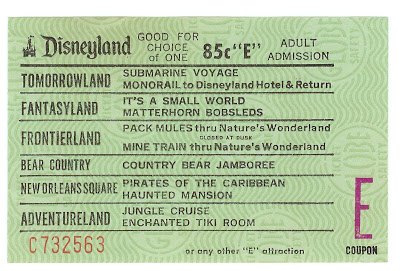
A reference only a select few will get. (85 cents?? Truly a bygone age)

While engaged in a very engaging conversation about screenwriting earlier this week, the person with whom I was conversing with asked the simplest and most straight-forward of questions:

“What do you like to write?”

Without a moment’s hesitation, I proudly stated, “Adventures.”

You can’t even say the word without implying the thrills and excitement it entails. Hands on hips, chest out, shoulders back, and a firmly-set jaw are automatically included.

I’ve enjoyed dabbling in other genres (such as drama and comedy), but nothing really grabs me like thinking up and writing out some sort of heart-pounding, edge-of-your-seat rollercoaster ride of a scene or sequence.

Those really never get old.

They say “Write what you know,” and although I’ve never actually fought monsters, manned a runaway train, or flown a space-faring vessel, years of reading and watching material of that type and nature has taught me an effective way of how to effectively inject adrenaline into what I’m writing.

More than a few readers have commented that my love and appreciation of the material and genre are boldly evident on the page, which is what I’m hoping  to accomplish every time.

My mantra has always been “Write something I would want to see”, and my list of future projects is jam-packed with numerous ideas and concepts that neatly fall into that category; each one a variation on the topic of discussion.

If these are the kinds of stories I was meant to write, you’ll get no complaints from me. I get a real kick out of cranking this stuff out. There’s no reason to think this can’t develop into what I build a career on and eventually become known for (he said, his fingers firmly crossed). My scripts. Rewriting someone else’s. Contributing to another. It’s all cool as far as I’m concerned.

Until then, all I can do is keep writing and making my readers feel their pulses quicken as they eagerly turn the page, absolutely spellbound to find out how the hero gets themselves out of this particular pickle, and, more importantly, what happens next.

Strap yourselves in, chums. This is going to be one helluva ride.