Questions? I got lots of ’em.

Steadily working my way through an always-growing queue of scripts in the “to read” pile. Most are for pleasure, while the remainder are for notes.

A majority of my notes usually tend to involve asking questions because something might not be clear to me. This is all part of my effort to try to understand what’s going on with what I’m reading, as I try to figure things out and get a better grasp of what information the writer is trying to convey.

If I don’t understand something, I’ll just come out and ask.

It can range from “I’m not sure why this character was doing that. What was their reasoning behind it?” to “What’s this character’s arc? How do they change over the course of the story?”

Having the writer provide the answer helps them figure out the solution, or at least opens the door for them. More so than I ever could, at least. I don’t want to be the type of note-giver who’s all about “This doesn’t work. I think this would work better.”

(I have seen more than my fair share of notes that include that sort of comment, and I don’t particularly care for them.)

The questions usually come about because something wasn’t clear enough to me. And if I don’t pick up on it, chances are the audience won’t either. Everything we need to know should be there on the page, whether written out or as subtext.

If more than a few of your readers ask the same questions or make the comments about something in particular, that’s an issue you’ll definitely need to address.

A reader wants to like the script they’re reading. They make comments and ask questions in order TO HELP MAKE YOUR SCRIPT BETTER. As the writer, it’s up to you how to interpret them. Sure, you don’t have to incorporate everything, but ask yourself “why did they say/ask this?”

It can be tough to read your own script and see what works and/or doesn’t. You’re too familiar with the material. This is why getting notes can be so invaluable. The reader hasn’t seen this AT ALL, so it’s all entirely new. If they come upon something in your script that stops the read because it makes them think “Wait a second. What does that mean?” or “Why did that happen?”, then you’ll need to fix that so it addresses the issue and makes sure it doesn’t happen for whoever reads it next.

Sometimes a writer will respond to my questions saying nobody had mentioned or asked about that before, but they could totally see why I was asking. This in turn helped them figure out a way to make the changes they felt would eliminate the reason for the questions in the first place.

Which is why I asked them.

A darned good use of one’s time

After a few very hectic weeks involving once again delivering the inimitable Ms. V to school, I’m settling back into my regular routine of reading- and writing-related activities.

And then some.

I did a whirlwind edit/proofread for a friend’s manuscript, read and gave notes on a couple of scripts (with a few more to go in the ever-expanding queue), and started the “wrap it up” phase of the outline for the microbudget project.

Apart from a smattering of fatigue, I’ve been having a great time working my way through it all.

There’s a special kind of buzz that comes with completing a project, and that’s certainly the case here.

I just enjoy the reading part of being a writer.

I don’t think I can maintain this kind of schedule indefinitely, but intend to do so as long as I can. Luckily for me, the responses to those that required notes and/or feedback have been positive, which helps.

This isn’t to say it’s all been work-oriented reading either. During our travels, I picked up a couple of books at a used book store. One a throwback to a sci-fi show from my youth, the other a collection of short stories set in our host city. Both made for some excellent “sit back, pass the time, and enjoy yourself” time.

I hope other writers get that special kick out of reading, whether it’s scripts, books, comics, or whatever. There’s something to be said for feeding the mind in such a way.

Plus, it helps you be a better writer. It’s definitely done wonders for me.

Reading: good and good for you

Wrapped up reading for a contest earlier this week. Happy to have helped, but it was exhausting.

And a good percentage of the writers could really benefit from this recent post.

Now that that’s out of the way, I can return to devoting more time on a few of my own projects, as well as start getting to the scripts in my “to read” queue.

I’m really looking forward to both, and especially the latter.

Some were sent with a request for notes, others were “thought you might enjoy this”, and the rest were ones that got my attention with the logline or the concept.

I’m extremely fortunate to have a professional relationship with a lot of these writers, and many of them are great writers to begin with, so it’s a pretty sure bet their scripts will also be of exceptional quality. And those are always great to read.

It can’t be stressed enough that reading scripts helps a writer become a better writer. So take it upon yourself to start making that a regular practice.

You’ll be glad you did.

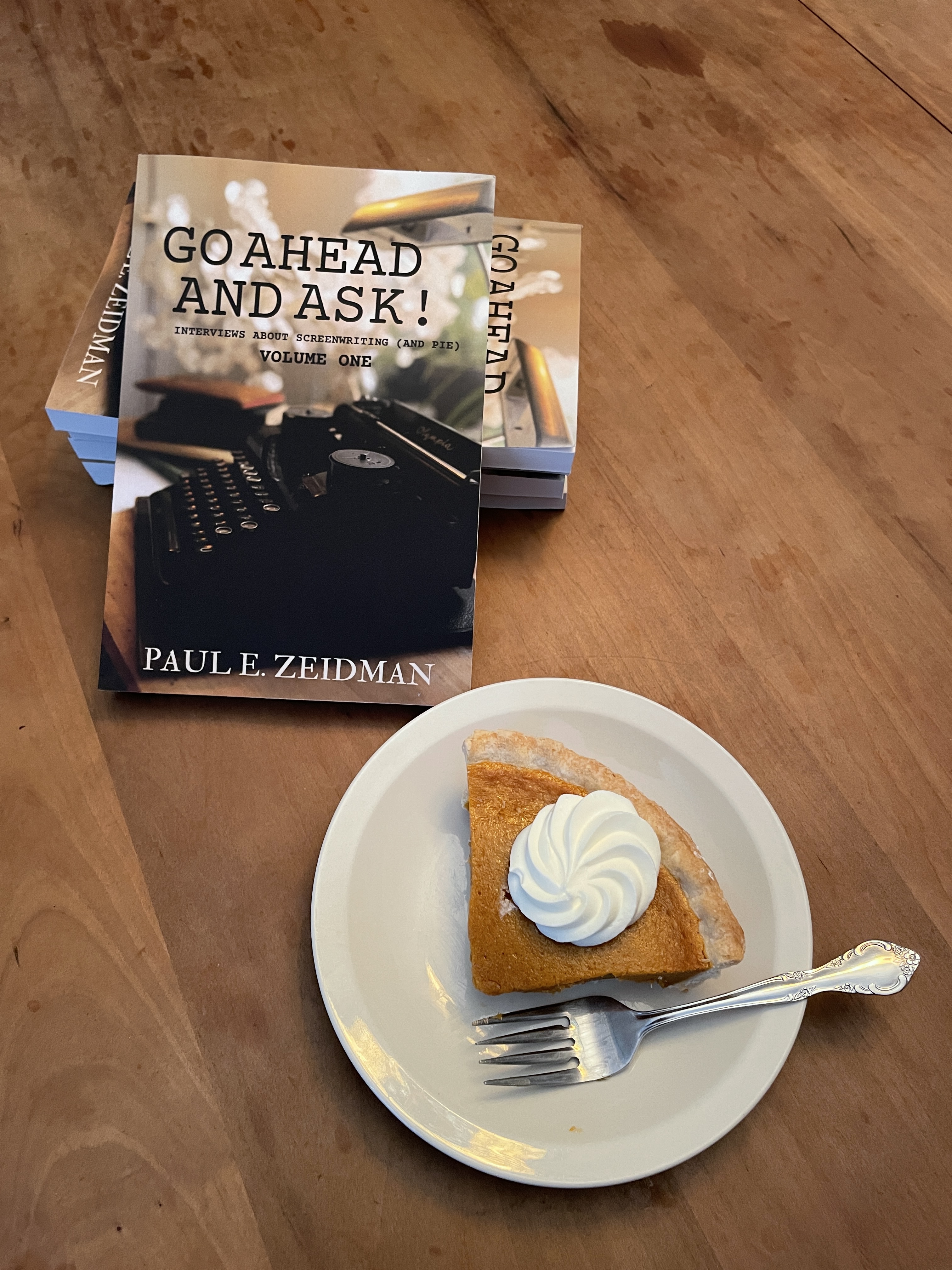
And speaking of reading, my new book GO AHEAD AND ASK! INTERVIEWS ABOUT SCREENWRITING (AND PIE) VOLUME 2 is now available in paperback and ebook here and here. It makes a great companion piece to Volume 1, and Volume 3 will roll out a little later this year.

Now available for your reading enjoyment

Well, today’s the day.

My book – GO AHEAD AND ASK!, VOLUME 1 – is officially available.

It contains 42 interviews with script consultants, and offers a wide variety of helpful advice that could benefit any screenwriter, no matter how much or how little experience they have, as well as each person’s contact info (where applicable), and of course, their favorite kind of pie.

And as the title indicates, this is the first volume. The second and third, featuring interviews with not only more consultants, but also screenwriters, filmmakers, and writers in other mediums, are slated for release in the late June/early July and mid-September timeframes, respectively.

In the meantime, I hope you’ll be interested enough in wanting to take a look at this one.

Thanks for reading, enjoy the book, and have a piece of pie with my compliments.

Reading for reading’s sake

This week I opted to give myself a bit of a break among the writing and outlining sessions, and read some scripts just for the hell of it. Admittedly, some of them had been in my “to read” queue for quite a while, and right now seemed as good a time as any to finally get to them.

No notes. No feedback. Just sitting back, relaxing, and losing myself in the stories.

They ranged from a horror to a historical action, a western to a drama based on true events.

And each and every one was fantastic in its own unique way.

It also helps that these are the works of some excellent writers to begin with, so that made the overall experience that much better.

If I’d been asked when I was starting out if I could ever just read a script, I’m not sure if the answer would have been yes. I suspect I’d’ve been too concerned with thinking “what works in this script?” and “what can I learn from this?”

But the experience that’s come from reading and writing scripts has enabled me to look at a screenplay as more than an educational document. I can see solid storytelling, strong plots, three-dimensional characters, snappy dialogue, and all the other elements.

All of those elements combine to make for some darned good scripts.

It’s one of the best pieces of advice when a newer writer asks “How can my scripts be better?”

READ SCRIPTS!

There’s a vast assortment from which to choose, making it super-easy for you to customize your reading list.

And to take it one step further, numerous members of the online screenwriting community would be happy to share or swap scripts. You just have to do the work in finding something that piques your interest. Believe me, they are definitely out there.

If your schedule allows, try to make the effort to read one to two scripts a week. You’ll be glad you did.