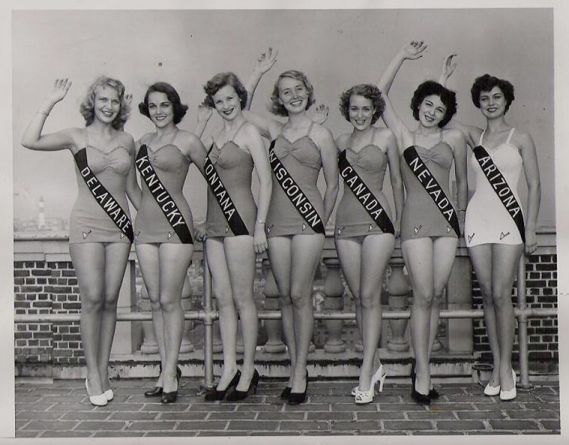
Maybe I have a shot at Miss Congeniality

Many will enter, but only one will win
Beneath these pleasant exteriors exist cunning, ferocious competitors

The past few weeks have been exciting to watch as the latest results were announced for some of the major screenwriting contests.

First, congrats to everybody who advanced! It’s always thrilling to see good things happen for friends and trusted colleagues. Make sure you let them know you’re glad for them.

And if your contest email included the word “Unfortunately,…” it’s not the end of the world. Believe me. There’s a long list of reasons why your script didn’t make the cut. It happens. We’ve all been there. Getting upset about it won’t do you any good. The sooner you put it behind you, the better off you’ll be.

Once you’ve gone through the last of the 5 stages, you’ve got several months to really embrace the opportunity to put more work into your script (or scripts) so you can resubmit it/them again next year.

You want your scripts to do better? Do the work to make them better. Get feedback. Pay for professional notes if you can. Whatever it takes. You’re going up against literally thousands of other writers and their scripts. This isn’t the time to hold back.

Entering contests was something I did not do this year, primarily because I didn’t think my scripts were ready. The western needs at least 1-2 more drafts, and I’m going back and forth as to which one to do after that. I’ve never entered two at the same time, but based on how the writing goes over the next few months, might consider it.

So consider me among those thousands competing against you next year, and remember that each and every one of us wants to win just as much as you do.

Good luck.

Bogie said it best

I’ve talked about this before, but recent events have warranted a revisiting of the topic.

When I connect with somebody or somebody connects with me on social media, I thank them and ask how their latest project is coming along. I ask because I actually am interested, and just think it’s cool to hear about what other people are working on.

There are several types of responses:

1. They describe what they’re working on, and end by asking me the same question. This happens the most frequently, which is great. It actually feels like a conversation, and I’ve made some great connections this way.

2. The cut-and-paste boilerplate response that reads exactly like one. “Thanks! Check out my video/like my Facebook page/donate to my Kickstarter, etc.” While I can understand this approach, it comes across as “I’m only connecting with you to get promote myself/my stuff”. I’ve never clicked through, and suspect a lot of others don’t either.

-An exception to this has been the rare combination of the above two. Someone described their project, included a link, and asked about me. The fact that they apparently made the extra effort to do a little of everything, without overdoing it, actually made me interested in checking out their link (which I did).

3. No response whatsoever. Perhaps you’ve not exactly grasped the concept that ‘social media’ includes ‘social’, as in ‘interacting with others’? Will I ever ever hear from you? It makes no difference to me that you dropped the ball on this, but if you’re not going to follow through on your end, then why bother doing this at all?

On that note…

3a. After sending my standard initial response, and getting no response, once in a while I’ll receive something like this (as I did earlier this week) from someone who’d asked me to connect several months ago: “Hey how’s it going? I’m what you call fresh meat to the industry so maybe you can help me”

My wise friend Bob sums it up quite nicely here, but I’d like to add my two cents.

You came to me, remember? Apparently not.

I responded, because I like to be polite in this scenario.

Then it was your turn, but you didn’t do anything. Now you’re back after a prolonged period of time with a very straightforward “I know we’ve never interacted before, but this is what you could do for me”.

I could, but I sure as hell ain’t gonna. (I’d be astonished if this person got even one response saying “Sure!”)

I hate to break this to you, but your networking skills suck. I’m more than happy to help somebody out if/when I can, but you have to earn it first. Popping out of my distant past with a generic plea for help isn’t going to do it.

I’ve put a lot of time and effort into building and maintaining my network of friends and trusted colleagues, and many of them have done the exact same thing.

Why haven’t you?

The fine art of interpreting notes

Not those kinds of notes
Oops. Wrong kind of notes.

It still needs some work, but the latest draft of the outline for the pulpy adventure is done, so it’s headed to the back-burner for now as focus shifts to rewriting/polishing the western.

I’ve been very fortunate the past few weeks to have received some high-quality notes for it, which includes a wide spectrum of suggestions of how it could be improved.

As expected, some have merit and some don’t (and this includes some professional comments), as well as a few changes not even originally considered. Each one gets serious consideration, but it all comes down to what I think works best for the story.

When I first started, I would assume every note I got was coming from somebody who knew better than me, but then there’d be so many changes/edits that the script was getting away from what I wanted it to be.

You and only you know what your script is supposed to be like. There will be many notes accompanying each subsequent draft. Don’t automatically think each one is right, but don’t immediately dismiss it either.

Ask yourself “Does this note help make my script better?” If so, how? If not, why not? If you’re not sure, look at it from both sides. Don’t rush just to get it over with. This requires a lot of thought, patience and attention.

It’s also important to not let your pride get in the way of the story. What’s more important – keeping your ego intact or making the story as good as it can be?

It took a while, but I eventually learned to trust my instincts to the point that I can now identify what I consider good notes and not-so-good notes, which has really made a difference in helping both me and my writing improve.

Riding that positive vibe

Nice and zen
Nice and zen

Not a lot to say today, but thought it would be nice to mention how I’m feeling kind of upbeat about the writing.

-Started the latest rewrite of the outline for the pulpy adventure spec. After some more researching and figuring stuff out, the story seems more solid and streamlined. Completing the previous draft took less time than expected, and hoping to repeat that this time around.

-Already developing ideas for the pending rewrite of the western. Those combined with some great notes I’ve received make me pretty confident in what the end result will be.

Enjoying this buoyant sensation while it lasts, and hope you’re feeling the same.

Something awfully familiar about this – OR – Already seen it

Not exactly the same, but mighty darn familiar
Whoa.

I was THIS CLOSE to being done with the latest version of the outline for the pulpy adventure spec when my writer’s sense starting tingling.

“Something’s still not right!” screamed out my internal editor.

What? That couldn’t be possible, could it? I’d spent the past few weeks being oh-so-meticulous in reorganizing sequences, working out subplots and connecting story points. How in the names of Walter Gibson and Lester Dent could there be a problem?

I looked at the outline with a more critical eye.

Opening sequence – check.
Intro of hero, establish his world – check.
Hero’s world drastically changes while raising central question of the story – check.
Complications ensue – check.
Midpoint where hero becomes fully committed to achieving his goal (accompanied by reminder of the central question) – check.

Wait. Back that up a little. To right between the “Complications” and “Midpoint” parts.

Hokey smokes, there it was. Cue the flashing red light bulb (with optional klaxon).

Two consecutive sequences just way too similar to each other. This is what’s been bothering me.

No doubt about it. One of ’em has to go. Probably the first one. You’d think it would be no big deal to just go in and change it.

And you’d be kinda/sorta wrong.

The events that happen during these two sequences are vital to the story, so the outcome needs to stay the same. The tough part now is figuring out how to change the “what happens” in that first one so not only is it unique enough unto itself, but also falls neatly into the overall structure of the story.

As always, a daunting task. For now. But potentially solvable given some time and exploration of possible alternatives.

I cannot stress enough the importance of why you should outline your story before even considering starting on pages, and being extremely thorough about it while you do. This is where you get all the heavy lifting done by figuring everything out. Where it’s a lot easier to identify the cracks in the foundation. Where it might take you a few passes to realize what works and what doesn’t.

Then again, this is how I do it, so your approach may be totally different. But speaking for myself, I prefer to go back in and fine-tune a couple of scene descriptions consisting of one to two sentences, rather than labor my way through several pages, then have to totally junk them because they’re not working.

So my focus for the time being is fixing this, then going through the whole outline a few more times, making adjustments where necessary, until I think it’s done/ready for conversion into pages.

-Got to see JURASSIC WORLD and INSIDE OUT last week. Both very enjoyable, but for very different reasons. Of the two, I’m more interested in seeing INSIDE OUT again, mostly for the writing and storytelling aspects.

Regrettably, still haven’t seen MAD MAX: FURY ROAD yet. Of all the summer releases, this feels like the one that must be seen on the big screen. Will do what I can to rectify that.