Make that sprawling epic a little less so

There can be such a thing as too much

An underrated bonus of working on a first draft is having the freedom to put in just about anything you think will work (provided, of course, it advances the plot, story and character development).

There will be the inevitable edits and rewrites afterward, but this is your chance to take that outline and really build on it.

But it’s also easy to overdo it.

All that witty dialogue, intricate scene descriptions or clever subplot you just thought up can quickly add up without you realizing it, and suddenly your tight, compact story has become a bloated, overstuffed mess.

Scripts usually run 90-120 pages – one page equals one minute of screen time. Does yours fall somewhere in that range? Anything more or less, and you’ve got some work to do.

If you ask somebody to read your script, one of the first things they’ll do is check out how long it is. 97 pages? Cool. 137? Unless you’re an award-winning filmmaker, not so cool.

“But there’s nothing I can cut!” you exclaim.

Wanna bet?

Once you’re done with your current draft, don’t look at it for at least a week; two would be better. Put it away and walk away. Focus on something else.

Then come back and just read it.  No editing, just reading.  Still think there’s nothing you can do with it?

Now the fun begins.  Go through it and really scrutinize each scene.

Is it absolutely crucial to the story? If so, can it be shorter?

All that great stuff you came up with on the fly – does it still work?

It may be tough at first to kill all those darlings, but more than likely, you won’t even miss them after they’re gone.

If you want to be a better writer, you have to learn how to not let your ego and emotions dictate your edits. In the end, both your script and writing skills will be the better for it.

Saying more with less

The digital version of this is inevitable

Logline and synopsis update!

Just some minor tweaking of the logline, and the synopsis is “good, but too long.” Could I maybe tighten it up, and how about ending with a cliffhanger?

You mean after spending so much time delicately crafting everything so it all flowed smoothly, I’m supposed to just go in and hack it all up?

Exactly.  Streamline what I already have, cut the non-essentials, and focus solely on the main storyline.

This was challenging, but it had to be done (and could potentially help me get over my dislike of writing a synopsis in the first place)

I worked my way through it and ended up with a tighter, better version, including a double cliffhanger.

One of the best pieces of writing advice I’ve ever heard was during a workshop with UCLA’s Richard Walter:

Write as if ink costs a thousand dollars an ounce.

Which are you more likely to want to read? A script with lots of white space on the page, or one with big, black blocks of dialogue and action lines?

It’s not enough to have a well-crafted story. You want the words and pages to really move, and a minimal amount of text can help make that happen.

Go through that scene you just finished. Figure out how to shorten it, keeping only what’s necessary.

Don’t think anything can be cut? Look again. Adverbs and prepositional phrases are good places to start.

You want the reading experience to be a breeze, not a slog. Too many words can do that.

-Finally attempted the Great Baklava Experiment. Apart from somewhat time-consuming and working with phyllo dough, not as difficult as I thought.  Maybe a little too much sauce, which is probably better than not enough.

Overall, consider it a success.

Now to figure out what to make next.

There’s always one more thing

Is this becoming a dated reference? Probably.

22 pages to go in the rewrite. Hoping to wrap it all up very, very soon, although I may give myself one more read-through just to be on the safe side.

I can’t stress enough how incredibly helpful it’s been to look this over after having not read it at all for a couple of weeks. You’d be surprised what you find when you look with fresh eyes.

The primary objective here was to incorporate some of the suggestions from my manager’s notes. I’d say that’s been accomplished, but there’s been more.

The discovery of two spelling errors cleverly disguised as non-misspelled words. Further proof of why you shouldn’t rely solely on spellcheck.

A small continuity problem that played a key part in moving the story forward. Fortunately, I was able to find the appropriate scene to set things up, which hopefully makes the payoff that much more satisfying.

Want to really tighten things up? Eliminate prepositional phrases wherever possible. They show up a lot more than your realize.  Learning to write without using them as much can only be a good thing.

Even though I’m in the home stretch, there are maybe one or two more story details that need to be addressed. The more questions I can answer, the better.

-Further proof I have some kind of future-telling ability: Luc Besson and Scarlett Johannson are teaming up for a modern-day action flick called LUCY. You heard that name here first, friends. Coincidence? Doubtful.

-IRON MAN 3 comes out next week. Looking forward to it. Shane Black wrote and directed it. Apparently he’s interested in taking on a Doc Savage movie. Joy beyond belief.

-Oh, and this is my 400th post. Thanks for sticking around.

My, how you’ve grown!

I assure you everything is under control
Despite how it may look, I assure you everything is under control

I wouldn’t say the first draft is becoming bigger than I could have possibly imagined, but when a scene in the outline is 1-2 sentences, and it takes 2-3 pages to properly execute it, then chances are pretty good that overall page length is something to keep an eye on.

Fortunately, this is a first draft, so the primary goal for now is just working through the story and putting it all on the page. At the rate I’m going, I wouldn’t be surprised if this thing hits around 150.

Not an issue for a high-profile pro, but way too much for somebody like you or me.  Would you want to read a potential 2-1/2-hour spec? Me either.

This is another item added to the mental scene checklist  – on top of everything else, can this scene be written as short as possible and still do what it has to? (moving the story ahead, character development, etc.)

Take a look at this post by John August from 2007, which has also been turned into a very useful infographic every writer should print out and keep near their workspace.

I’ll worry about the numerous edits and changes that will no doubt be necessary later.

For now, I’m focusing on reaching the finish line, page length be damned (but still kept in mind).

My mettle is being tested, and then some

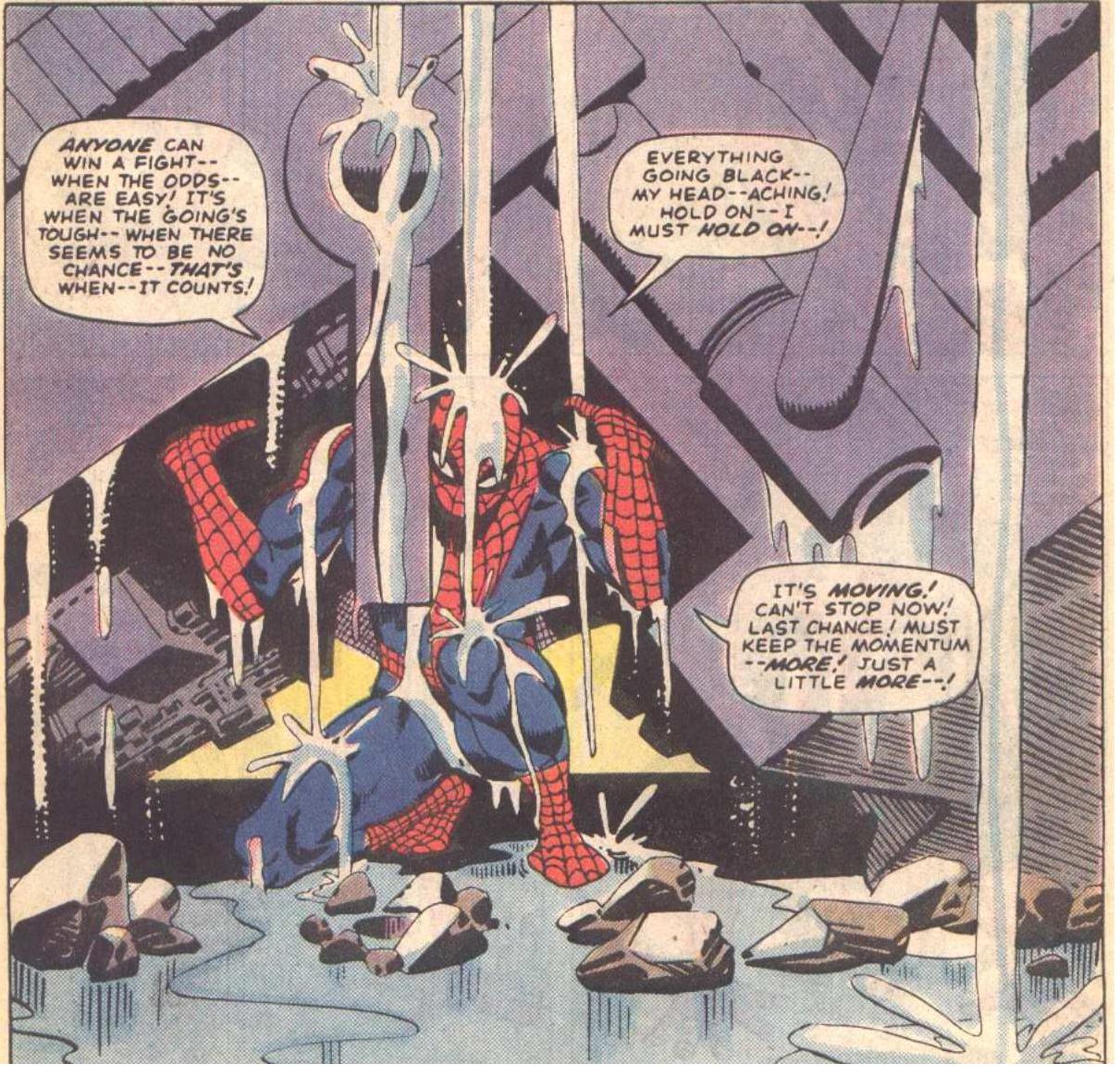
Some days can feel like this...
We’ve all been there, Spidey.  Metaphorically speaking, of course.

A week after receiving my query letter, an agent responded, asking for a one-page synopsis.  Fortunately, I had one ready to go and sent it, trying hard to not get my hopes up.

The response came just under an hour later, including this:

“Sorry to say it doesn’t promise a unique storyline with surprises that would appeal to the young audience.”

Okay…

Not sure I would necessarily agree with most of that, but then again, I’m slightly biased.

What could have made them say this? Was my synopsis bad? Did the gist of the story not come across? Is this just another way of saying “Thanks, but not what we’re looking for?”

Hard to say.  Oh well.  Nothing else I can do about it.

So with my hopes temporarily dashed on the rocks below, onward I continue.  (Don’t worry. My hopes are pretty resilient, and should be back on their feet relatively soon.)

Probably like a lot of writers, there’s always going to be that dreaded feeling of second-guessing myself. Did I do enough? Is this right?

I could (and do) ask myself these questions, but the more time I spend worrying about them, the less productive I am.

It all comes down to doing the best I can, putting it out there and seeing what happens. Hopefully, it’ll yield positive results. If not, I’ve got no choice but to fix the problem where I can and see if that works.

They don’t call it a never-ending process for nothing, you know.

I’ve been working at this for quite a while, getting a little closer to success each time. The goal is obtainable, and I can do this. This long, drawn-out part can be pretty frustrating, but I’ve made it this far. A little longer won’t be that bad.

-Movie of the Moment: CABIN IN THE WOODS (2011)  I don’t really care for horror, but this was fun. If Joss Whedon is involved, you know it’s going to be written smart. I’d heard there was a unique twist to it, and there was (no spoilers here).

What was most impressive was how they took a lot of horror movie tropes and made them integral parts of the plot, including the all-important setting up and paying off.