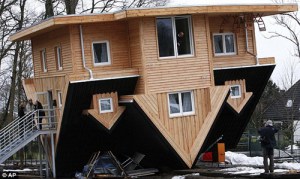
Ain’t that a kick in the head

Coming soon to a computer near you!

I apologize for the lack of posts over the past few weeks. I’ve been developing a big new project, and now I can finally talk about it.

I’m going to be hosting a weekly hour-long online radio show about writing and movies on Radioslot.com. It should launch in the next few weeks. Keep in mind this is NOT a podcast, which you can download and listen to anytime you want. This will have a designated live broadcast time, and possibly one to two rebroadcasts in the week until the next new show.

Since the show will be done live, there may be a chance for listeners to email questions/comments, which could be addressed live.  Tthe emphasis will be on writing and movies, but knowing me, there will probably also be the occasional dip into assorted other fields, such as comics and webcomics.  I’m also in the process of setting up some interviews.  I had a great guest for my audition show, and hope to bring him and his partner back.

Once everything is finalized, I’ll set up a link.  Despite my cool exterior appearance, I’m actually all aflutter.  Exciting times, indeed.

Suffice to say, my writing progress has taken somewhat of a hit during this time. Maybe about 7 or 8 pages, but I’m hoping to get a little more back on track soon.

-Movie of the Moment – CHRONICLE (2012). This was one of the first 2010 Black List scripts I read, and was looking forward to seeing it.  Putting my enjoyment of superhero flicks aside, this was quite well done.  It took a realistic approach to a fantasy subject, and didn’t short-change either side.

Parts of the script warranted a hard R rating, but those parts were toned down to make it PG-13, and I wonder if keeping it as originally written would have worked better. Case in point – the spider scene  stayed the same, but the script has Andrew doing the same thing to his father in the hospital room. While that would have been pretty messy, but just dropping him seemed not as effective.  I also remember the final showdown (the original script is set in Portland, Oregon) as having more spectacle to it.

Don’t get me wrong. This was a lot of fun and definitely worth your time.
Is it funny?

A friend read my Chinese restaurant comedy last week. He said he really enjoyed it, adding he “hadn’t laughed that much in a long time.” I’m glad he feels that way. Every comedy writer hopes somebody thinks their work is funny, but his comments got me thinking.  I’ve read lots of comedies, but they usually don’t make me laugh.

This has always been a problem for me.  Don’t know why. The last thing I remember laughing out loud while reading was a Blackadder script.

A lot of times I’ll hear about a script making the rounds that’s supposed to be hilarious.  I’ll read it and wonder “what’s the big deal?”  I guess it takes a certain eye to process and enjoy comedy in written form, but I don’t seem to have it.  More power to those who do.

It’s a lot easier for me to enjoy and appreciate a good joke in it’s intended form, such as a movie or tv show. It also helps to not be the only one watching.  A comedy with an audience of one is never as funny.

It’s even easier to laugh at something audio-based, like a podcast.  Many’s the time I’ve had to stop running because I was laughing so hard at something I just heard.  Would I have this kind of reaction if I had read the bit, rather than heard it?  Hard to say.

My friend said he’d pass the script on to some his industry pals.  Can’t help but wonder if they’ll think it’s funny.

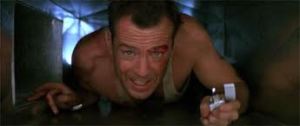
When all else fails, go to DIE HARD – or – Thank you, John McClane

An action film done right

Unusually busy this week, including initial prepping for a potentially huge project, so not much progress on the rewrite front.  I also feel like I’ve been ignoring LUCY, so I brought the trusty notepad to last night’s hockey practice in an effort to see what I could come up with.

I’m up to around the page 75 mark, and need to get to the end of Act Two.  The action and stakes have to be ramped up, and just about everything in that part of the initial outline wasn’t going to work.  Simply put, I’m starting over.  Sometimes that can be good and inspirational, but looking at that blank page didn’t help.

My good guys need to reconnect with the bad guys. The situation has to be progressively harder for them, with the title character driving things forward.  But how to make this happen?  Ding! The light bulb appears.  Pick ’em off, one by one, leading to the showdown in Act Three! That’s it! Wooo! And what better an example of this than DIE HARD?

*Side note – you gotta admit it’s incredibly cool that DIE HARD is now considered a Christmas classic, right up there with A CHRISTMAS STORY and IT’S A WONDERFUL LIFE.  No holiday season should be without watching it.

While there have been numerous copies, some done right, some not, this is a great blueprint to follow for a solidly-constructed action story.  Hard to find any big flaws in it.

For an entertaining analysis/review, click here.

Now that I have an idea of how to move ahead, I can work out the details of how to break up each sequence into 2-3 scenes per scenario, all of which will lead into the “all is lost” moment at the end of Act Two.  I still have a few gaps to fill, but confidence is running high.

Gotta tell ya – feels pretty good to overcome a seemingly insurmountable obstacle.

Stop thinking and write!

proof that a script is like a blueprint; everything has to fit perfectly

A very interesting thing happened during the first scene of the rewrite of the second half of DREAMSHIP.  I got about halfway through when I realized my hero was just sitting there, doing nothing.  And that ain’t right!  He’s supposed to be the one driving the action, pushing the story ahead.  Fortunately, it’s easily fixed.  But it got me thinking.

Since finishing the first half rewrite, I’m more careful going into each scene.  You could even call it overthinking. Does this scene advance the story, theme and character? (A cardinal but often-ignored rule for screenwriting)  Does it follow the one before it and lead to the one after it?  If I take it out, will it impact the rest of the story?  I also realize taking the time to analyze each scene with such intense scrutiny will slow me down.  The feeling of getting stuff done will vanish.

In some ways, just storming ahead seems like a great way to go.  But then there’s the whole issue of going back and fixing things.  But if I apply the proverbial fine-tooth comb, then it won’t be fun.  And will take longer than I’d like.

I think rather than move ahead on pages, I’ll go through the outline and edit accordingly, thereby saving valuable time during the page-writing period as well as trimming some fat from the story.

-I’ve read some of the scripts from the 2011 Black List. So far, not too impressive.  I liked the 2010 selections much better.

-Movie of the Moment – 9 (2009). A really interesting animated film that came and went from theaters pretty quickly.  I can see why.  Set in a post-apocalyptic world, a band of foot-high dolls struggles to survive.  This is probably not the best way to describe it, but it’s all I can think of.

While the story is a little unusual, I thought it was a great take on the genre.  Really clever use of the animation and each doll had a distinct personality and appearance that made it easy to distinguish one from another.

My only complaints:  a slightly confusing resolution to the main conflict, and a lot of back-and-forth in terms of moving the story forward.  I think the main character said “We have to go  back!” at least twice.  It’s never explained how the dolls function, but in the end doesn’t really matter.

I didn’t realize this was based on a ten-minute short, which was included on the DVD, but I didn’t get a chance to watch it.  Tim Burton and Timur Bekmambetov were among the producers, and it’s easy to see the influence of each.

A mini-saga in editing

A little bubbly for a little milestone

In only a little less than four hours, I managed to complete a pretty strong rewrite of the first half of DREAMSHIP.  Even better, I was able to cut enough to take it from 62 pages to 55, which is much more acceptable.

Being able to really trim the fat not only helps the script flow better, but also improves your writing.  The more you can say with fewer words, the better.

It was surprisingly easier than expected to manipulate the scenes to get the most out of them.  Maybe it was drastically cutting whatever wasn’t needed, or finding a way to cut a scene by half, or combining two scenes into one.  No matter what was needed, I did it.  This included cutting a line I absolutely loved, but it had to go.  Besides, I can always use it later.

I especially liked getting rid of a drawn-out sequence that was too similar to something earlier in the story and reworking it so it was shorter, different and made my protagonist be more active and help drive the action.  Good things all.

But that’s enough high self-praise. Time to move on to the second half.  If I can be as strategic in the initial writing phase as I  am in the later editing, AND I can do a healthy output of pages per day/week, then this thing will be ready to go sooner than anticipated.

No complaints.

-I haven’t been able to read many scripts lately, especially those from the Black List.  For the most part, I’ve been underwhelmed by a lot of this year’s selections, and ScriptShadow has been covering a lot of them.  I’ll go over the list again and see if anything catches my eye.  Any suggestions?